
DGO5.23 Interactions with Deaf and Hard of Hearing Individuals
San Francisco Police Department GENERAL ORDER Document ID5.23
5.23.01
POLICY
It is the policy of the San Francisco Police Department (Department) to provide the highest level of service to all community members, including individuals who are Deaf or hard of hearing. Under federal and state law, including Title II of the Americans with Disabilities Act of 1990 (ADA), Section 504 of the Rehabilitation Act of 1973, and California Government Code section 11135, the Department has legal obligations to ensure members communicate effectively with individuals who are Deaf or hard of hearing and that these individuals are not subjected to unlawful discrimination. Individuals who are Deaf or hard of hearing are entitled to the same level of services as hearing individuals and shall not be excluded, segregated, or denied assistance whether they are a suspect of a crime, are in custody or detained, a victim or witness of a crime, or a person in need of assistance.
5.23.02
PURPOSE
The purpose of this policy is to outline procedures members shall follow when encountering an individual who is Deaf or hard of hearing and the services available to meet these legal obligations. The Department shall provide all services necessary to effectively communicate with an individual free of charge including a qualified interpreter or the appropriate preferred auxiliary aid requested by the individual.
SFPD stands for safety with respect for all. We will
- Engage in just, transparent, unbiased, and responsive policing
- Do so in the spirit of dignity and in collaboration with the community
- Maintain and build trust and respect as the guardian of constitutional and human rights.
5.23.03
DEFINITIONS
- American Sign Language (ASL) – The primary sign language used in North America, ASL is a complete, visual language with its own grammar and syntax that uses the shape, movement, and placement of hands as well as facial expression and body posture to convey information.
- Auxiliary Aids – Tools, equipment, items, and /or services used to effectively communicate with an individual who is Deaf, hard of hearing, and/or has low to no vision. These include assistive listening devices, qualified interpreter services, written communications and materials, pads, pens, gestures, telecommunication devices (TDDs), videophones, and video remote interpreting devices (i.e., computers or tablets).
- Certified Deaf Interpreter (CDI) – A qualified interpreter who is Deaf or hard of hearing.
- Deaf-Blind Individual – An individual who has limited to no functional hearing ability and uncorrectable low vision and/or the complete lack of light perception who may rely on a tactile form of communication.
- Deaf or Hard of Hearing Individual – An individual with limited to no functional hearing ability who relies on a visual system for communication instead of processing linguistic information through hearing, with or without amplification, and also includes individuals who may have a hearing loss because of age, illness or trauma.
- Exigent Circumstance Exception – An exigent circumstance arises when an officer has specific and articulable facts that a particular action was performed by an officer due to concerns of the person’s, the safety of others or the safety of the involved officer(s).
- Lip and Speech Reading – Technique of understanding speech by visually interpreting the movements of the lips, tongue, and/or face.
- Do not assume that a Deaf or hard of hearing individual reads lips. Even when a Deaf individual reads lips, only 25% of spoken language is visible on the lips.
- Individuals’ lip or speechreading skills may diminish for a variety of reasons, including stress trauma, sleep deprivation, or the influence of alcohol or medication.
- Qualified Interpreter – A person certified by the National Registry of Interpreters for the Deaf who is able to interpret and translate effectively, accurately, and impartially both receptively and expressively, using any necessary specialized vocabulary (including basic law enforcement terminology) taking into consideration the language skills and education of the individual in need of services. As well as their preferred method of communication (sign language, video relay, etc.). Qualified interpreters should have no other responsibilities than interpreting. Because a qualified interpreter must be able to interpret impartially, a family member, child, or friend of the individual who is Deaf may not be qualified to render the necessary interpretation because of factors such as professional, emotional, or personal involvement, or considerations of confidentiality.
- For an individual who is Deaf or hard of hearing and uses American Sign Language for communication, the term "qualified interpreter" means a certified interpreter skilled in communicating in American Sign Language or Signed language.
- The term "qualified interpreter" encompasses relay interpreter teams, when such are necessary for effective communication.
- Relay Interpreter Teams – Two or more persons used to communicate with an individual with very minimal language skills including ASL. The team works together using a variety of methods to effectively convey information to and from the individual.
- Signed Language – A form of communication employing the signing characteristics of American Sign Language but using the grammar of the preferred language in place of ASL syntax.
- Tactile and Low Light Interpreting – Communication techniques to relay linguistic information by feeling the interpreter’s hands while the interpreter signs or fingerspells. Low light interpreting may be used with individuals who can see signs, but only at very close range with added illumination, such as lighting the interpreters face and hands.
- Text to 9-1-1 (Real Time Text) – Allows mobile users to send a text message to a 9-1-1 Dispatcher in situations where people cannot voice a call to 9-1-1.
- Video Relay Service (VRS) – Telecommunications relay service that allows individuals who rely on sign language to communicate over the telephone using Videophones in real-time, via a sign language interpreter.
- Video Remote Interpreting (VRI) – An interpreting service using video conferencing technology to communicate with individuals who use American Sign Language for short, same room conversations. The Federal Communication Commission prohibits VRS use as a substitute for in-person interpretation or Video Remote Interpreting (VRI). Members shall not request a Deaf or hard of hearing person to use VRS on their phone or use VRS as an interpreting service.
- Videophone – A device with a video camera that can perform bi-directional video and audio transmissions between people in real-time.
5.23.04
PROCEDURES
In order to provide an equivalent level of service when encountering individuals who are Deaf or hard of hearing, members shall follow all procedures to ensure effective communication is established and maintained through the contact. Members shall review and use the Guidelines for Effective Communication (Attachment A).
Establishing Effective Communication
Officers shall follow up with Dispatch to advise the need for a qualified interpreter or appropriate auxiliary aids to ensure effective communication when encountering a Deaf or hard of hearing individual.
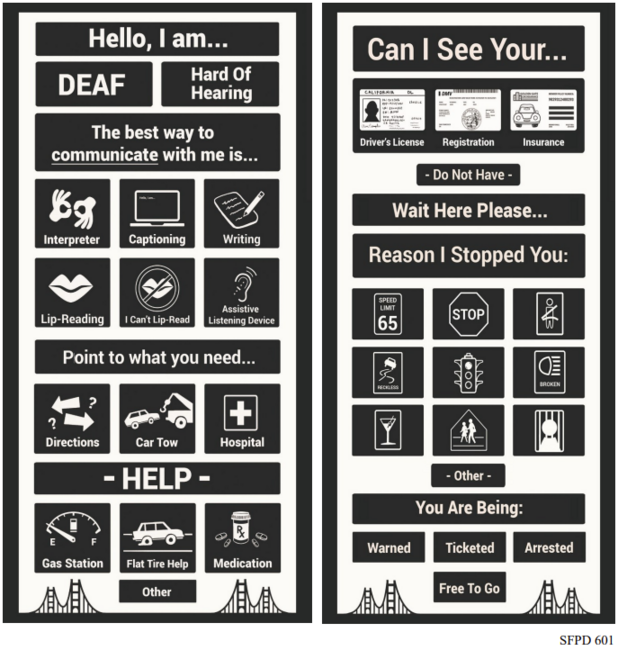
Using the Department-issued Communication Card (SFPD Form 601) either electronically or via hard copy, the member shall determine and employ the individual’s preferred method of communication to include, but not limited to, the following services, equipment, or resources defined in Section 5.23.03 B. Auxiliary Aids; written communication (e.g., pen and paper, text messaging), Qualified interpreters (in person and through video conferencing), TDD/TTY, 711 telephone relay service or Text to 911 (RTT) via DEM.
- If the individual uses sign language, determine whether the individual uses American Sign Language.
- If the individual uses American Sign Language (ASL), the member shall use their department-issued cell phone or other electronic device to obtain an ASL video interpreter immediately, absent an exigent circumstance (see Sec 5.23.03 F.), if preferred by the individual.
- If the individual requests the use of written communication, the member shall provide paper and pen/pencil or other method for written communication and shall communicate with the individual in writing.
- Written communication shall not be a substitute where the individual expressed a preference for a sign language interpreter.
Throughout the interaction, members shall reassess communication effectiveness by asking the individual on a continuing basis if the selected method is meeting their needs required for effective communication. For example, while a video ASL interpreter accessed through a member’s department-issued cell phone may be an effective way to communicate with a Deaf driver while checking the driver’s license and explaining the reason for stopping the driver, further questioning at a station may require an in-person interpreter.
If the individual’s preferred method is not available due to the following circumstances, the member shall document in the incident report the reason the preferred method was not used and the alternate method(s) used to communicate:
- The individual’s preferred method would cause a significant undue burden, given the circumstances, length, complexity, and importance of the communication, as well as the communication skills of the individual, and another equally effective way of communicating is available;
- An exigent circumstances defined in Sec 5.23.03 F., does not permit the use of the individual’s preferred method or
- The individual’s preferred method is for family members, neighbors, friends, volunteers, bystanders, or children to provide sign language interpretation, as described in Section C. Restrictions.
- When the situation limiting access to the preferred method of communication has subsided, the member shall provide the appropriate auxiliary aids and services consistent with this policy and will confirm or supplement the initial communication as soon as practical using the appropriate auxiliary aids and services.
The lengthier, complex, and important the communication, the more likely that an in-person qualified interpreter will be required to communicate effectively with an individual whose preferred method of communication is sign language.
Except in exigent circumstances, members must follow the Establishing Effective Communication procedures described above in all circumstances involving an individual who is Deaf or hard of hearing, including when:
- interviewing a reportee, victim, witness or complainant;
- interviewing or interrogating a criminal suspect;
- conducting enforcement actions such as a detention, traffic stop, search, an arrest or execution of a search warrant;
- questioning a suspect following a detention or a pat search; and
- taking a detainee or arrestee to a station.
- If the individual uses sign language, determine whether the individual uses American Sign Language.
Exigent Circumstances
As defined above, an exigent circumstance arises when an officer has specific and articulable facts that a particular action was performed by an officer due to concerns of the person’s, the safety of others or the safety of the involved officer(s).
- When there is an emergency situation involving an immediate threat to the safety of the public or the officer and there is insufficient time to make available appropriate auxiliary aids or services, members may use whatever auxiliary aids or services most effective under the circumstances to communicate with individuals who are Deaf or hard of hearing, consistent with an appropriate law enforcement response to the threat. This may include, for example, exchanging written notes or using the services of an individual who knows sign language but who is not a qualified interpreter, during the emergency situation.
- When the emergency situation has subsided, the member will provide the appropriate auxiliary aids and services consistent with this policy and will confirm or supplement the initial communication as soon as practical using the appropriate auxiliary aids and services.
Restrictions
Family members, friends, and other unqualified third parties shall not be used as interpreters absent exigent circumstances.
- If an exigent circumstance requires an officer to use family members, neighbors, friends, volunteers, bystanders or children for initial interpretation, the officer shall seek the assistance of a qualified sign language interpreter to confirm or supplement the initial interpretation as soon as practical.
- A family member may interpret where an interpreter is not required, i.e., a passenger may interpret for a Deaf individual who asks for traffic directions.
Handcuffing
When communicating with or relaying information to an individual who is Deaf or hard of hearing, such as during an interview or interrogation, and a member deems it necessary to handcuff the individual, members will, safety permitting, reasonably modify standard operating procedures and handcuff the individual with their hands in front to enable the individual to communicate using sign language or writing.
Consent
A member may not obtain consent to enter or to search from a Deaf or hard of hearing individual until the Establishing Effective Communication procedures of Section 5.23.04 A. have been followed, and a qualified interpreter, if required, has been provided. For consent searches of private residences, members are required to obtain explicit consent in writing or verbally. Written consent shall be documented using the Permission to Search Form (SFPD 468). Verbal consent shall be recorded using the Body Worn Camera and/or digital recorder. Written or verbal consent shall be obtained prior to conducting a consent search of a suspect’s residence.
- Reportees, Victims, Witnesses or Complainants
- If a qualified interpreter is necessary to communicate effectively, the member shall request a qualified interpreter within an hour of contacting the reportee, victim, witness or complainant, unless an exigent circumstances exists. The best method for effective communication is to have the qualified interpreter, the interviewer/member and the Deaf or hard of hearing individual in the same room.
- If a qualified interpreter is not available to provide in-person interpretation services within two hours of the member’s request, members may use video interpreters through the member’s department-issued phone or other computer device. For lengthier interviews or those concerning felony conduct, officers shall, when feasible, access a video interpreter on a large screen device to better facilitate viewing of the interpreter. Members shall document the reason an in-person interpreter was not available and the method the officer used to communicate as required by Section 5.23.04 A. Establishing Effective Communication.
- Members shall record the interview in accordance with Department General Order 10.11 (Body Worn Cameras).
- Suspects of Crime
- In conducting any criminal, traffic, or other investigation, no member shall rely solely on statements of others, without communicating effectively with a Deaf and hard of hearing individual, if the member would have communicated with a similarly situated individual who was not Deaf or hard of hearing.
- If it is determined, through the Establishing Effective Communication procedures outlined above, that a qualified interpreter is necessary to communicate effectively with a criminal suspect who is Deaf or hard of hearing and a member wishes to interrogate the criminal suspect, members must not interrogate the suspect or administer Miranda warnings to the suspect until a qualified interpreter has arrived. Further, members must provide notice to the suspect that the SFPD shall defer the interrogation pending the arrival of in-person qualified interpreter.
- California Evidence Code section 754 mandates qualified interpreters for individuals who are Deaf or hard of hearing in civil and criminal cases. Evidence Code section 754 (k) states that a written or oral statement made by a Deaf individual cannot be used against that individual unless the statement was made or elicited through a qualified interpreter.
- When the qualified interpreter arrives, the Miranda warning shall be administered to the criminal suspect through the qualified interpreter.
- Members shall record the interview, including the issuance of the Miranda warning.
- Detentions, Pat Searches, Arrests, Charging and Booking Information
Detentions and Pat Searches- In circumstances where a member, without communicating with the Deaf or hard of hearing individual, has a reasonable suspicion that justifies a detention or a pat search, consistent with DGO 5.03, the member may conduct a detention or a pat search, respectively, of that individual, without first following the Establishing Effective Communication procedures of Section 5.23.04 A.
If, following the detention or pat search, the individual is free to go without any further communication, the Establishing Effective Communication procedures of Section 5.23.04 A. need not be followed, unless the Deaf or hard of hearing individual indicates a desire to communicate further. In that instance, members shall follow the Establishing Effective Communication procedures of Section 5.23.04 A. The member shall also inform an individual who was detained that the individual is free to go.
- Stations
Information - Information generally provided to detainees or arrestees at the stations shall be communicated effectively and promptly to detainees or arrestees who are Deaf or hard of hearing. This information includes, but is not limited to:
- the notice of the right to counsel,
- the nature of the charges,
- the right to a telephone call,
- the procedure for posting bond or obtaining release, or
- any other information that is generally provided to detainees or arrestees in similar circumstances.
This information shall be provided to the detainee or arrestee who is Deaf or hard of hearing immediately.
Members should also seek information from the arrestees or detainees concerning any medical issues or medication needs.
In circumstances requiring an in-person interpreter, such services shall be requested no later than one hour after arrest or detention unless emergency circumstances exist. If an in-person interpreter is not available within two hours, officers shall use alternate communication tools as described in 5.23.03 B. Auxiliary Aids and document the reason the method was not available and the method the officer used to communicate as required by Section 5.23.04 B.
- Phone Access - In instances where hearing individuals would be permitted a telephone call at a district station, including the right pursuant to Penal Code section 851.5 to make at least three completed phone calls no later than three hours after arrest, members shall provide individuals who are Deaf or hard of hearing with their choice of an operable TTY or Videophone to enable them to place a telephone call with the same degree of independence and privacy that would be permitted to similarly situated individuals absent any hearing disability.
- Holding Cells - Pursuant to San Francisco Police Department’s Booking and Detention Manual Page 7, Deaf or hard of hearing individuals shall not be detained in district station holding cells.
Signage
At all district stations and any other SFPD building open to the public, SFPD will post conspicuous signs in public areas advising individuals who are Deaf or hard of hearing the availability of auxiliary aids and services, including qualified interpreters, free of charge. The posted signs will include the International Symbol for Hearing Loss, the International Symbol for TTYs, and a sign to indicate the availability of sign language interpreters:
Available Auxiliary Aids & Services
Image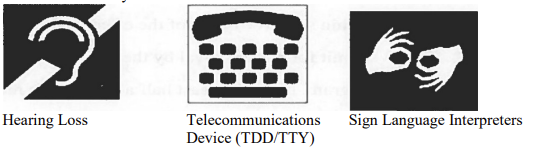
- Documentation
- Whenever an incident report is prepared involving a Deaf or hard of hearing individual, the member shall check the “Interpreter Needed” box on the face sheet and shall include in the narrative the manner(s) in which the member and the Deaf or hard of hearing individual communicated and if an interpreter was used, the name of the interpreter, the manner in which the interpreter provided assistance (i.e. American Sign Language), and whether the interpreter was in person or off-site through video conferencing. Supervisors shall ensure that members are in compliance with this this Department General Order.
The Department shall collect Deaf and hard of hearing data as to all calls for service, contacts and investigations that require an incident report. In a yearly report to the Police Commission, the Department shall provide data concerning: 1) the number of calls for service, contacts and investigations involving Deaf and hard of hearing individuals where an incident report was required; 2) the manner in which services were provided; 3) any complaints involving interactions between SFPD officers and Deaf or hard of hearing individuals; and the Department’s resolution to these complaints.
This data can be reported in the same yearly report that SFPD is required to provide concerning LEP data and services pursuant to Department General Order 5.20 Section (III)(O)(3).
District Access Liaison Officers
The Department, through the Chief or designee, shall appoint two officers at each district station and SFPD Units and Divisions with public contact. These personnel will be responsible for providing assistance to Deaf and hard of hearing individuals in their interactions with police officers, identify needs for training on Deaf and hard of hearing issues and facilitate through Training Coordinators, assisting officers to resolve communication needs involving Deaf and hard of hearing individuals, and ensuring that information about SFPD’s services for Deaf and hard of hearing individuals are available at the stations.
Language Access Liaison Member’s duties to Include Managing Services for the Deaf and Hard of Hearing Individuals
The Department shall designate the responsibilities of the Language Access Liaison member established through Department General Order 5.20 to include monitoring compliance with this General Order and related policies, meeting with the Department of Police Accountability, Mayor’s Office of Disability and community groups to discuss and resolve complaints arising from police interactions with Deaf and hard of hearing individuals, and ensuring services for Deaf and hard of hearing individuals are available at the stations, on the Department’s website, and at community events where possible.
Training
The Language Access Liaison member in partnership with the designated officers described in Section 5.23.04 L., shall develop training to implement this Department General Order, including the ADA requirements regarding effective communication with individuals who are Deaf or hard of hearing. The training will incorporate scenarios and be sufficiently practice-oriented to enable members to effectively implement all provisions of this DGO, including how to identify and provide the appropriate communication tools and work with an on-site and off-site interpreter. The Department shall conduct such trainings for new recruits, at in-service training or at Roll Call for SFPD members at least every two (2) years. The Language Access Liaison should include feedback from members of the community in the development and coordination of training surrounding interactions with Deaf and hard of hearing individuals. Initial training shall be provided within 120 days of the Police Commission’s adoption of this General Order.
Airport Bureau
Airport Bureau members providing services at the Airport will contact Airport Communications when language assistance is required at the San Francisco International Airport.
ATTACHMENT A
(Front and Back of Communication Card for Officers)
ATTACHMENT B
GUIDELINES FOR COMMUNICATING EFFECTIVELY WITH PEOPLE WHO ARE DEAF OR HARD OF HEARING
- Before speaking, get the individual’s attention with a wave of the hand or a gentle tap on the shoulder —keeping in mind the desire to avoid unnecessarily frightening the individual.
- Identify yourself.
- Attempt to speak in a well-lit area.
- Face the individual and do not turn away while speaking.
- Do not cover your mouth or chew gum.
- If an individual is wearing a hearing aid, do not assume the individual can hear you.
- Minimize background noise and other distractions whenever possible.
- When you are communicating orally, speak slowly and distinctly. Use gestures and facial expressions to reinforce what you are saying. • Use visual aids when possible, such as pointing to printed information on a citation or other document.
- Do not assume that a Deaf or hard of hearing individual reads lips. Remember that only about one third of spoken words can be understood by lip-reading.
- When communicating by writing notes, keep in mind that some individuals who use sign language may not be proficient in reading and writing English.
- If someone with a hearing disability cannot understand you, write a note to ask what communication aid or service is needed.
- If a sign language interpreter is requested, be sure to ask which language the individual uses. American Sign Language (ASL) and Signed Language are the most common.
- When you are interviewing a witness or a suspect or engaging in any complex conversation with an individual whose primary language is sign language, a qualified interpreter is usually needed to ensure effective communication.
- Talk at your normal rate, or slightly slower if you normally speak very fast.
- Only one individual should speak at a time.
WORKING WITH A SIGN INTERPRETER
- Qualified sign language interpreters are professionals bound by a Code of Ethics. Their role is to ensure that all information is understood and accurate.
- Speak directly to the Deaf or hard of hearing individual, NOT the interpreter. Avoid saying to the interpreter, “tell them.”
- Only one individual should speak at a time. Speak at a normal pace and volume.
- Do not speak privately to the interpreter in the presence of the Deaf and hard of hearing individual.
- Interpreters will interpret everything you say. Do not have side conversations or whispers.
- An interpreter may interject for clarification or corrections.
- Provide the interpreter with any written materials that will be used prior to the appointment.
- Consistent with DGO 5.17, Bias Free Policing, use the sign interpreter to explain the basis of SFPD actions, such as the basis for a stop, search, or delay.
- Before concluding the interaction, ask the interpreter if they or the person they are assisting wish to add or repeat information.