
Department Drone Policy Unit Order Issued to Tactical Company (TAC) (24-02)
Unit Order
Unit Index Number: 24-02
Date Issued: 5/16/24
Subject: Phase One UAS Deployment (in partnership with TSU)
Issued to: Tactical Company (TAC)
Issued by: Captain James Aherne #1095
PURPOSE:
This Unit Order provides standardized operating procedures for authorized Department personnel who are assigned responsibilities associated with the deployment and use of an unmanned aircraft system (UAS). It includes instructions on when and how this technology may be used for law enforcement and public safety purposes in accordance with the law.
DEFINITIONS AND TERMS
Unmanned Aircraft System (UAS): An unmanned aircraft of any type that is capable of sustaining directed flight, whether preprogrammed or remotely controlled, including all supporting or attached systems designed for gathering information through imaging, recording, or any other means.
Unmanned Aerial Vehicle (UAV): A small, unmanned aircraft less than 55 lbs.
Operator: A sworn member ("member") of the San Francisco Police Department who has either received an FAA Remote Pilot's License (Part 107 rule) or has received training and is authorized/certified under the Department's Certificate of Waiver Authorization (COA). Th e member is assigned to TAC or TSU, and trained, certified, and authorized to control a UAS during flight. An operator is also known as a pilot or remote pilot.
Visual Observer: A member of the San Francisco Police Department in either TAC or TSU who is trained and authorized to maintain visual observation of the UAS while in flight.
Phase One: The initiation of Department drone deployment that includes six drones distributed first to TAC and TSU. Drone usage during Phase One will determine the infrastructure and scope needed for the next phases of Department drone deployment. Due to the limited scope of this phase, UAS use will not represent a department-wide roll out.
Pre-planned deployment mapping: A process that allows for early review and mapping of potentially dangerous locations related to specific high-risk investigations or operations ahead of deploying officers to that location or ahead of tactical entry to increase officer and subject safety.
Certificates of Waiver or Authorization (COA): This is an authorization given to government and public safety agencies to be able to self-certify UAS and operators for flights performing governmental functions. If the department does not have a COA they may operate under a 14 CFR part 107 (below 400 feet and visual line-of sight operations only).
ROLES AND RESPONSIBILITIES
- PROGRAM MANAGER
TSU will have oversight of the UAS program and designate a Program Manager. This role ensures the program operates in accordance with all Federal, State and local laws and within department policy and guidelines.- Authorizing UAS trainings for members
- Reporting: Manage FAA required reporting, including accident/injury reports that must be posted within 10 days of occurrence.
- Review and approve monthly flight log for public posting (see Standard Reporting in this order).
- UAS OPERATOR
Members assigned to either TSU or TAC who are responsible for the safe operation of the UAS in accordance with applicable law and policy.- Accept or reject an operation based on factors such as weather, safety concerns, other conditions which would result in an unsafe operation.
- Reporting: The operator shall complete and submit the Flight Summary Report prior to the end of their shift.
- The operator shall be responsive to requests and input from the observer in order to accomplish the safe and effective deployment of the UAS.
- UAS VISUAL OBSERVER
Members assigned to either TSU or TAC whose role is to assist in the safe and effective operation of the UAS. The Visual Observer shall:- Assist the operator in avoiding obstacles.
- Operate any attachments to the UAS.
- Remain alert for safety issues surrounding the operator and observer.
- Manage radio communications with responding officers and UAS operator.
AUTHORIZED USE
UASs are authorized to be used to assist with active criminal investigations. UASs are authorized to be used along with or in lieu of vehicle pursuits when the UAS technology and capability becomes generally available to Law Enforcement Agencies. UASs are authorized to be used during training relating to the assessment and evaluation of the authorized use.
DRONE DEPLOYMENT RESPONSIBILITIES DURING PHASE ONE
Provide aerial support & situational awareness to responding officers during:
- Active criminal investigation operations
- Spontaneous criminal investigations at the discretion of the UAS Program Manager or designee
- Response to Major & Critical incidents as defined by SFPD General Order 8.01
Use of UASs shall conform with all federal, state, and local laws to ensure individual's constitutional rights are protected, including all applicable regulations of the Federal Aviation Administration (FAA). UASs shall be operated and used in compliance with SFPD policies and procedures and in accordance with UAS manufacturers' approved flight manuals. UAS equipment may be deployed in the following locations: the City & County of San Francisco, SFO property, and SFPD operations outside of San Francisco.
PROHIBITIONS AND RESTRICTIONS
Department owned UASs, their accessories, or features/functionalities shall not be used:
- Forth e purpose of infringing on the lawful exercise of rights protected by the First Amendment.
- For a non-law enforcement related matter.
- In an unsafe manner or in violation of any applicable law, rules, or regulations.
- The UAS shall not be equipped with weapons of any kind.
- The UAS shall not be a force option.
When the UAS is being flown, operators will take steps to ensure the camera is focused on the areas necessary to the mission and to minimize the inadvertent collection of data about uninvolved persons or places. Operators and Observers shall take reasonable precautions, such as turning imaging devices away, to avoid inadvertently recording or transmitting images of areas where there is a reasonable expectation of privacy, unless authorized by law.
No guideline can anticipate every conceivable situation or exceptional circumstance which Members may face. In all circumstances, Members are expected to exercise sound judgment and critical decision-making during drone deployment.
PROCEDURES
Critical Incident related requests for UAS deployment shall adhere to DGO 8.01 process. For all other UAS requests, members shall notify the DOC. The available TSU or Tactical personnel, when contacted by the DOC, shall notify the UAS Program Manager or special operations lieutenant, or designees, before responding. For any operation outside of Tactical Operations, the Tactical Unit will help TSU or patrol during Phase One, when feasible.
Operators are authorized to evaluate and decline any mission or portion thereof due to policy or safety concerns or other FAA requirements.
MINIMUM PERSONNEL REQUIREMENTS
Standard Operations (operations without a Beyond Visual Line of Sight (BVLOS) waiver):
- Due to the nature of the law enforcement mission, the minimum personnel required on missions are two, a Operator/Pilot and Visual Observer ("UAS team members"). During exigent circumstances, an Operator/Pilot may launch their UAS without a Visual Observer to maintain operational visibility of the scene. A Visual Observer should accompany the Operator, including trainings.
FLIGHT RESPONSIBILITIES
- UAS team members will handle all UAS operations, notifications and all necessary pre-flight guidelines required by the FAA.
- UAS night flights are authorized in the SFPD COA addendum and Part 107 waiver (In Progress). For purposes of night flights, the following apply:
- Additional training will be provided on the lighting configuration of the UAS to ensure proper recognition during night flight operations.
- Prior to conducting flights, the Operator and Visual Observer must be trained to recognize and overcome visual illusions and limitations caused by darkness.
- The Operator and Visual Observer must ensure the area of operation is sufficiently illuminated to allow the UAS team members to identify people and obstacles on the ground; or the Operator and Visual Observer must conduct a daytime site assessment prior to conducting night operations, noting any hazards or obstructions.
- The UAS must be equipped with anti-collision lighting visible from no less than 3 statute miles. In the interest of public safety, the Operator may reduce the intensity of the lighting if he or she determines it is necessary.
- The following applies to flights over people while operating under the COA or Part 107:
- The ground speed of the UAS must not exceed 100mph.
- Operate an aircraft at an altitude that will allow, in the event of a power failure on the UAS, an emergency landing without undue hazard to persons or property on the surface.
- For those operations where it is necessary to operate over people to safeguard human life, the operator must not operate any lower or in proximity to people than is necessary to accomplish the operation.
- The UAS Program Manager will manage the required FAA reporting and chain of command review if there is an accident that results in at least serious injury to a person or a loss of consciousness, or if there is property damage in excess of $500. This report is due to the FAA within 10 calendar days of the accident that meets the above criteria.
TRAINING REQUIREMENTS
- UASs will only be operated by Department Members who have been trained in the operation of the system, possess a current FAA Part 107 certificate with a UAS rating, and are authorized by the UAS Program Manager.
- The UAS Program Manager shall conduct an annual qualification of all Department Part 107 pilots.
- Visual Observers must have completed sufficient training to communicate to the pilot any instructions required to remain clear of conflicting traffic. Th is training, at a minimum, shall include knowledge of the rules and responsibilities per FAA guidelines.
TRAINING RECORDS
- All UAS Team Members will have a training file on record that details their training history. This training file will be kept with the members' other training files at the SFPD Academy.
- All deployments or training exercises will be documented in a flight log and count towards UAS Team Member's training.
- It is the UAS Team Member's responsibility to verify their training file contains all pertinent information.
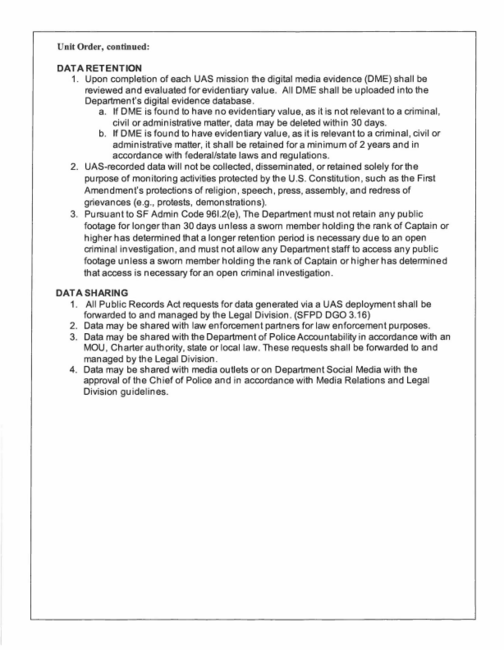
DATA RETENTION
- Upon completion of each UAS mission the digital media evidence (OME) shall be reviewed and evaluated for evidentiary value. All OME shall be uploaded into the Department's digital evidence database.
- If OME is found to have no evidentiary value, as it is not relevant to a criminal, civil or administrative matter, data may be deleted within 30 days.
- If OME is found to have evidentiary value, as it is relevant to a criminal, civil or administrative matter, it shall be retained for a minimum of 2 years and in accordance with federal/state laws and regulations.
- UAS-recorded data will not be collected, disseminated, or retained solely for the purpose of monitoring activities protected by the U.S. Constitution, such as the First Amendment's protections of religion, speech, press, assembly, and redress of grievances (e.g., protests, demonstrations).
- Pursuant to SF Admin Code 961.2(e), The Department must not retain any public footage for longer than 30 days unless a sworn member holding the rank of Captain or higher has determined that a longer retention period is necessary due to an open criminal investigation, and must not allow any Department staff to access any public footage unless a sworn member holding the rank of Captain or higher has determined that access is necessary for an open criminal investigation.
DATA SHARING
- All Public Records Act requests for data generated via a UAS deployment shall be forwarded to and managed by the Legal Division. (SFPD DGO 3.16)
- Data may be shared with law enforcement partners for law enforcement purposes.
- Data may be shared with the Department of Police Accountability in accordance with an MOU, Charter authority, state or local law. These requests shall be forwarded to and managed by the Legal Division.
- Data may be shared with media outlets or on Department Social Media with the approval of the Chief of Police and in accordance with Media Relations and Legal Division guidelines.