

Program Goals
Reduce gun violence.
Reduce individual recidivism and victimization rates.
Build trust between law enforcement and impacted communities.
Strategy
The Violence Reduction Initiative (VRI) works to prevent gun violence by identifying individuals most at risk and connecting them with intensive, personalized support.
Launched in 2020, the San Francisco VRI focuses on reducing gun violence specifically in District 10 but support all citywide efforts. The program engages people at the highest risk, meets with them to discuss their involvement in gun violence incidents, and offers resources to help change their trajectory.
Participants are connected with Life Coaches who provide intensive mentorship aimed at behavioral change and risk reduction. These coaches maintain ongoing relationships through regular check-ins, accountability conversations, conflict mediation, and crisis intervention helping participants navigate immediate challenges and stay on a safer path.
Through referrals, participants gain access to a broad network of supportive services, including mental health counseling, housing assistance, job training, and financial support, tailored to their individual needs.
Many Life Coaches bring lived experience with the criminal justice system, giving them credibility and a deep understanding of the obstacles participants face. This approach is grounded in trust and authentic relationships, recognizing that lasting change comes from support not enforcement alone.
District Impact and Citywide Outcomes
The Violence Reduction Initiative has contributed to measurable reductions in gun violence in District 10 and across San Francisco.
District 10 experienced a 50% greater reduction in homicides and non-fatal shootings compared to other city districts.
Citywide gun violence incidents declined by 19% in 2024, from 162 to 132.
These outcomes are supported by an external evaluation conducted by the University of Pennsylvania’s Crime and Justice Policy Lab. In parallel, internal analysis estimates the program has generated approximately $12–15 million in societal cost savings through reduced victimization and incarceration.
Advancing SFPD's Core Strategic Priorities
The Violence Reduction Initiative is a strategic operating model that directly supports and operationalizes the San Francisco Police Department's commitment to building a safer city through trust and effective prevention.
- Strategic Priority 1: Building Strong, Collaborative Partnerships
The VRI champions collaborative policing, shifting the focus from enforcement-only to collective action.
Integrated Action: SFPD works in lockstep with the Sheriff’s Department, District Attorney’s Office, Probation, key nonprofits, and community organizations. This unified approach demonstrates the Department's commitment to addressing violence comprehensively.
Strengthening Trust: This robust partnership model is designed to build bridges and strengthen relationships with community groups that have historically experienced distrust with law enforcement--fostering a unified front against violence.
- Strategic Priority 2: Enhancing Responsiveness & Procedural Justice
The VRI moves beyond reactive enforcement by addressing the root causes of violence and embracing the principles of Procedural Justice.
Prevention, Not Reaction: Instead of simply responding to crime, the VRI offers high-risk individuals mentorship, housing support, job training, and mental health services – connecting them with opportunity alongside accountability that reduce their at-risk behaviors and get them on a more positive path.
Proven Impact: This respectful, dialogue-based approach treats participants with dignity and yields tangible results, including reductions in recidivism and re-victimization, as well as an increased sense of community trust in police legitimacy.
- Strategic Priority 3: Transparent Metrics and Accountability
The VRI delivers concrete, externally validated data that defines "safety with respect" – demonstrating that improving public safety and building community trust are complementary goals. Our approach tracks outcomes at two distinct levels:
Public Safety Outcomes: Measurable reductions in gun violence incidents, homicides, and shootings across District 10 and citywide, validated by external evaluation through the University of Pennsylvania's Crime and Justice Policy Lab.
Program Metrics: Recidivism rates, victimization outcomes, and program engagement—providing insight into whether the intervention is reducing at-risk behaviors and activities for those most vulnerable to violence involvement.
This dual-level accountability demonstrates that improving public safety and building community trust are not competing priorities but reinforcing outcomes. Transparent reporting on both dimensions shows SFPD's commitment to evidence-based intervention and measurable responsibility to the communities we serve.
- Strategic Priority 4: Strengthening the Department from Within
The VRI is a model for the community-oriented policing values SFPD is building toward, integrating prevention expertise directly into departmental culture.
Integrated Teams: The program models an advanced approach by pairing sworn officers with specialized civilian staff and community-based Life Coaches.
Building Skills: Officers in the VRI gain a deeper understanding of community needs and develop critical skills in de-escalation, relationship-building, and trauma-informed engagement, setting a new standard for policing practice.
- Strategic Priority 5: Planning and Leading for the Future
As a cornerstone of Strategy 2.0, the VRI represents forward-thinking violence prevention that adapts and innovates.
Adaptable & Scalable: The program continuously adjusts to changing violence dynamics across the city, incorporates stakeholder feedback, and generates scalable models that are currently being studied by other departments nationwide. Through our partnership with the University of Pennsylvania's Crime and Justice Policy Lab, the VRI actively contributes to the expanding field of community violence prevention.
Innovation Leader: By rigorously testing and documenting our model, SFPD is advancing the field of violence prevention research and practice. This positions the department as a leader in evidence-based intervention – rather than being limited to reactive crisis management – while strengthening the knowledge available to communities and departments nationwide working to reduce gun violence.
Key Partners
The VRI works across multiple city agencies, community organizations, and nonprofit partners to support participants. This coordinated approach – combining accountability, intervention, and opportunity – is essential to interrupting cycles of violence:
“The San Francisco Adult Probation Department recognizes that the San Francisco Police Department’s Violence Reduction Initiative (VRI) program will allow for better outcomes for the individuals who have been involved in gun violence and re-entering our communities.”
“SF Pretrial is a longstanding partner in violence prevention and intervention efforts across San Francisco. We are proud to collaborate with the San Francisco Violence Reduction Initiative (SF-VRI), a multi-agency, community-centered strategy focused on reducing gun violence in the city’s highest-risk neighborhoods.”
“The San Francisco District Attorney’s Office is committed to partnering with the SFPD and their VRI Unit to make communities safer. Together we can reduce gun violence and support those impacted.”
“SVIP joins together in the belief that helping reduce gun violence, promoting community, and building stronger communication networks reduces future criminal activity and enhances neighborhood revitalization.”
“[SFSO] believe this approach is critical to the work in San Francisco and will also help to support our goal to reduce local custody time in our county jails by reducing the numbers of arrests.”
“The University of Pennsylvania Crime and Justice Policy Lab is excited to support SFPD’s application to Cal VIP… our research team is committed to helping SFPD improve and expand its program through process evaluations and impact evaluation to measure program outcomes.”
How Referrals Work
Community members and service providers can refer individuals to the VRI at any time. We review every referral against our eligibility criteria and prioritize individuals at highest risk of gun violence.
If a referred individual meets our criteria, we'll contact them to discuss the program and next steps. Due to limited capacity and specific enrollment requirements, not all referrals result in immediate enrollment. Those who don't currently qualify will be connected with complementary community resources or placed on a waitlist for future consideration.
- ReportsImage
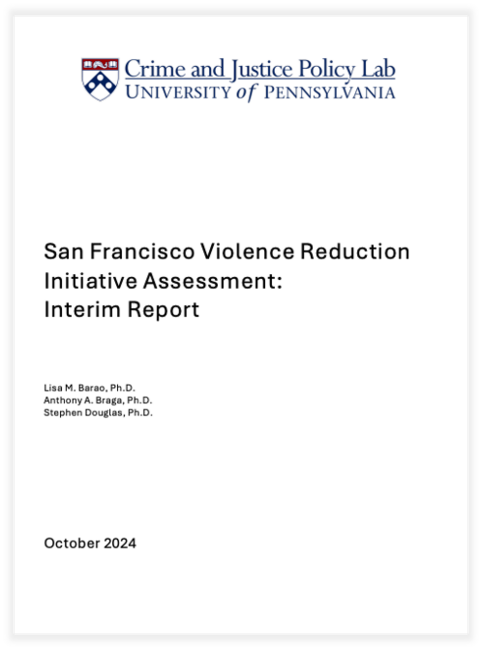
San Francisco Violence Reduction Initiative Evaluation by Dr. Anthony Braga (2024): The evaluation finds that San Francisco’s Violence Reduction Initiative (VRI)—implemented in District 10 using focused deterrence, direct engagement, and services for individuals at highest risk—was associated with a statistically significant 50% reduction in homicides and nonfatal shootings in that district during 2022–2023 relative to the rest of the city, after controlling for other factors; this suggests that roughly half of the observed reduction in serious violence in District 10 can be attributed to the program’s implementation. The analysis shows that these reductions were greater than trends in other parts of San Francisco, indicating a stronger localized impact where VRI was fully deployed compared with areas that did not receive the intervention. While the report emphasizes promising results and supports the continuation and possible expansion of the initiative, it also notes that causal attribution has limitations and recommends further rigorous evaluation as the program grows. For more information or copies of the report, please contact us via the link below.
Image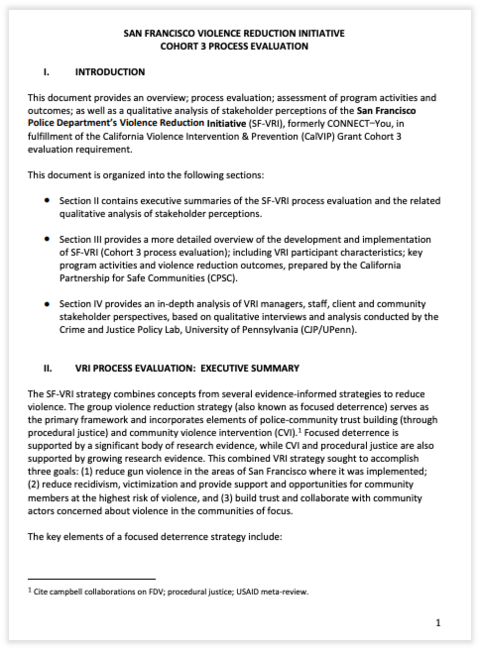
BSCC Cohort 3 San Francisco Local Evaluation Report (Violence Reduction Initiative): The report reviews the implementation and outcomes of the San Francisco’s Violence Reduction Initiative funded by the California Board of State and Community Corrections (BSCC) as part of Cohort 3, detailing program activities, process evaluation, and outcomes. It highlights significant reductions in key gun violence indicators from 2020 to 2023, including a notable decrease in homicides and non-fatal shootings in targeted areas like District 10, while noting the report does not establish causal links between the initiative and these trends. The evaluation combines quantitative trends with qualitative analysis to assess the initiative’s progress toward its goals and provides insights for future public safety strategies in the city. For more information or copies of the report, please contact us via the link below.
- Press Releases
- Police Commission Presentations
- News Articles
San Francisco Chronicle: 09/20/24
San Francisco on pace for lowest number of homicides since 1960CBS News: 12/10/24
San Francisco homicide rate lowest in decades as 2024 wraps up, officials say - CBS San FranciscoSan Francisco Chronicle: 12/10/24
New program credited for drop in shootings in S.F.'s BayviewMission Local: 10/21/25
No anti-violence programs in the Tenderloin — yetNBC Bay Area
San Francisco to host gun buy-back event