24-126 Enforcement of Laws to Address Lodging, Encampments on Public Streets, Sidewalks, Plazas, or other Public or on Private Property or Blocking Access to those Areas
Department Notice

The purpose of this Department Notice is to provide updated guidance to all Members with enforcement options for any persons sitting, lying, sleeping, or lodging on public property following the U.S Supreme Court's decision in Grants Pass v. Johnson, 144 S.Ct. 2202 (2024). This Department Notice is directed to all Members in the Department, regardless of their assignment.
In light of the Grant Pass decision, on July 8, 2024 the Ninth Circuit issued an order vacating portions of a partially granted preliminary injunction against the City in the United States District Court, Northern District of California that were based on the Eighth Amendment restrictions on cruel and unusual punishment and had prevented the City from enforcing, in certain circumstances, certain designated laws that prohibit sitting, lying, sleeping, and lodging on public property. (Case No. 22-cv-05502-DMR).
Background and Direction
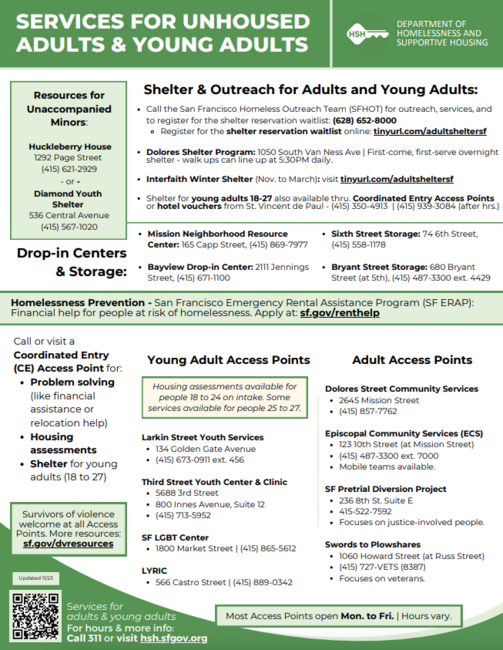
In its Grants Pass decision the U.S. Supreme Court holds that the enforcement of generally applicable laws regulating camping on public property does not constitute "cruel and unusual punishment" barred by the Eighth Amendment. In doing so, the Court overturned Martin v. Boise, 920 F.3d 584 (2019), and clarified that the government is not required to first offer available shelter before enforcing generally applicable laws. Practically, this means Members may enforce the below laws without first assuring that the City has made offers of available shelter under the Eighth Amendment. But, while not required to do so, Members and staff in other appropriate departments are encouraged to provide to persons experiencing homelessness a Department provided palm card, containing information about the City's shelter programs and available services.
A. Laws Governing Lodging and Encampments on Streets or Sidewalks
There are three categories of state and local laws that various City personnel may enforce to address lodging and encampments: (1) criminal and civil nuisance laws; (2) criminal laws prohibiting sitting, lying, and lodging; and (3) laws that prohibit interfering with a public officer or peace officer in the performance of their employment or duty. Below is a summary of the primary laws that the City may enforce in these situations and the identities of the City personnel responsible for enforcement of those laws.
1. Criminal and Civil Laws- Nuisance and Obstruction of Streets or Sidewalks or Private Property and Business Premises
Public Nuisance - Cal. Penal Code § 370-372. These sections (misdemeanor) prohibit conduct that: 1) is injurious to health, indecent or offensive to the senses, and interferes with the comfortable enjoyment of life or property by any considerable number of persons; or 2) obstructs the free passage or use of any public park, square, street, or highway.
Obstructing streets or sidewalks - Cal. Penal Code § 370-372 and Cal. Penal Code § 647c. These sections prohibit obstructing streets and sidewalks in certain circumstances. As mentioned above, Penal Code §§ 370- 372 (misdemeanor) prohibit any obstruction of the free passage or use of any public park, square, street, or highway. Penal Code § 647c (misdemeanor) prohibits willfully or maliciously obstructing the free movement of any person on any street, sidewalk or public place. (Refer to DGO 6.11.)
S.F. Police Code §§ 22-24. S.F. Police Code §§ 22-24 (1st offense infraction; 2nd offense misdemeanor) prohibit willfully and substantially obstructing the free passage of any person or persons on any street, sidewalk, passageway or other public place. For example, if the person's belongings obstruct access to a public facility or do not allow a 48" wide path of travel on a public sidewalk, Members may take enforcement action.
This portion of the Notice provides Members with multiple possible code sections as listed above [Cal. Penal Code §§ 370-372, 647c; S.F. Police Code §§ 22-24] that Members may use in their discretion to determine what code section(s) may apply. For example, and without limitation, community members report a disturbance in their neighborhood where they observe a person blocking the sidewalk and see them hauling household items to build an encampment. The community members also observe rubbish on the street emanating a strong odor of human waste and spoiled food. Depending upon results from their investigation, Members may use Cal. Penal Code §§ 370-372 if a community member is willing to serve as a witness and the elements of the code are met. If there is not a community member willing to serve as a complainant, Members may still consider using S.F. Police Code §§ 22-24. If the investigation reveals the person's conduct is willful and malicious, such as the person admits to the Member that they willfully placed their items on the street to block pedestrians, Members may also consider using Cal. Penal Code § 647c.
S.F. Police Code §§ 25-27. These sections (1st offense infraction; 2nd offense within 24-hours misdemeanor) prohibit "willfully remain[ing] upon any private property or business premises after being notified by the owner, lessee, or other person in charge thereof to leave" or entering upon private property or business premises "without permission, expressed or implied, of the owner, lessee, or other person in charge of private property or business premises ... after having been notified by the owner, lessee, or other person in charge thereof to keep off or to keep away therefrom."
Private trespass - S.F. Police Code §§ 25-27. (1st offense infraction; 2nd offense misdemeanor). These sections prohibit entering and remaining on private property if the owner, tenant, or other person in charge has given notice to leave or keep away. Notice may be oral or written, posted in a conspicuous place, describing the specific area and hours in which persons are to keep off or to keep away. The second offense within 24 hours of citation or 120 days of conviction is a misdemeanor. SFPD has made available to private property owners "PC 25" signs that advise persons that they have no permission to sleep, lie or remain within a doorway, and request the SFPD to enforce Police Code § 25 in their absence.
Generally applicable requirements: To the extent Members are assisting City agencies with the enforcement of any of these nuisance or encroachment laws for purposes of cleaning up or maintaining City streets or sidewalks, Members shall document the accumulation of trash, debris, litter, rubbish or other objects or structures that violate state or local laws.
2. Criminal Laws Prohibiting Sitting, Lying and Lodging
Sit/Lie - S.F. Police Code § 168. (1st offense infraction; 2nd offense within 24 hours-misdemeanor with possible imprisonment for 10-days; violation within 120-days of conviction misdemeanor with possible imprisonment for 30-days). The City's "Sit/Lie" law, S.F. Police Code § 168, applies to any persons, including individuals in an encampment, who are sitting or lying on the sidewalk between 0700 hours and 2300 hours in violation of that section. Members must first warn the person that their conduct violates this section before issuing a citation for an infraction or misdemeanor. But, Members may issue a warning and a citation during the same contact -- if the person refuses to comply with the Member's warning. This section does not apply to persons who are:
- Sitting or lying down on a public sidewalk due to a medical emergency;
- Using a wheelchair, walker, or similar device as the result of a disability;
- Operating or patronizing a commercial establishment conducted on the public sidewalk pursuant to a sidewalk use permit;
- Participating in or attending a parade, festival, performance, rally, demonstration, meeting, or similar event conducted on the public sidewalk pursuant to and in compliance with a street use or other applicable permit;
- Sitting on a fixed chair or bench located on the public sidewalk supplied by a public agency or by the abutting private property owner;
- Sitting in line for goods or services unless the person's possessions impede the ability of pedestrians to travel along the length of the sidewalk or enter a doorway or other entrance alongside the sidewalk;
- A child seated in a stroller; or
- In an area designated by the City as a Pavement to Parks project.
Unauthorized Lodging - Cal. Penal Code § 647(e). This section (misdemeanor) prohibits individuals from lodging "in any building, structure, vehicle, or place, whether public or private, without the permission of the owner or person entitled to the possession or in control of it." Lodging can include a wide range of conduct indicating an intention to settle down in a specific location for an indefinite period of time. Members should look at the totality of the circumstances to determine whether a person is lodging, and the Member shall document the specific elements that shows a person is "lodging," which requires more than mere sleeping.
(a) Lodging in any building, structure, or place whether private or public without permission of the owner or person entitled to the possession or in control of it is prohibited. A person who erects a tent or other structure or who otherwise establishes an encampment may violate Penal Code § 647(e). Members may cite for violation of Penal Code § 647(e) for lodging on the street only when the individual to be cited has erected a tent, tarp or other structure, encampment, or shelter. A person does not need to be observed inside of their tent, encampment, or structure for there to be a violation of Penal Code § 647(e), so long as the Member confirms that the person cited owns or is in possession and control of the tent, encampment, or structure.
(b) Members may cite for a violation of Penal Code§ 647(e) and Police Code 97, if a person is lodging in a vehicle, house car, camper, or trailer coach between the hours 10:00 p.m. and 6:00 a.m. Through the enactment of Police Code 97, the City has expressly prohibited the use of vehicles on a City street, park, beach, square, avenue, alley or public way for purposes of lodging. Members should look at the totality of the circumstances and determine whether there are factors indicating the person is lodging in the vehicle, which is more than just sleeping. Member should articulate factors that show signs of lodging and the vehicle is being used as a dwelling place such as whether the vehicle is inoperable, the vehicle is using an unauthorized electrical power source, the presence of fire hazards, such as cooking with open flames outside the vehicle, the acquisition of food that suggests persons intends to cook or store food in the vehicle for over an extended period of time, the vehicle has not moved over a 72-hour time frame, there is accumulation of rubbish and trash stemming from the vehicle that spills over to the streets, and the inappropriate disposal of human or animal waste.
Members may consider Cal. Vehicle Code § 22655.5 (a) or (b) for authority to tow vehicles as evidence of a crime.
3. Resisting, Delaying, or Obstructing a Public Officer or Peace Officer
Cal. Penal Code § 148(a). This section (misdemeanor) prohibits any person from willfully resisting, delaying, or obstructing any public officer or peace officer, including DPW, DPH, and HSH personnel, who is discharging or attempting to discharge an official duty, including the enforcement of any law. For example, during joint operations Members may cite an individual for violating Penal Code § 148(a), where the City has complied with other local laws and the individual refuses to comply.
Important Generally Applicable Reminders
Members are reminded to activate their Body Worn Cameras (BWC) in accordance with DGO 10.11 in connection with enforcement of any of these laws.
DGO 9.07 does not apply to enforcement of any persons sitting, lying, or sleeping on public property because 9.07 applies to enforcement of pedestrians and operators of vehicles as defined in the Cal. Vehicle Code.
DGO 9.07.04(A)(8) has deprioritized enforcement of Police Code 97 for any person who is merely sleeping in a vehicle unless there is a joint operation with other City departments. Penal Code § 647(e) prohibits lodging in a vehicle, which requires more than merely sleeping. If Members take enforcement action against a person who is lodging, Members may cite to Penal Code § 647(e) or S.F. Police Code 97, or both.
Members are reminded to take enforcement action against any criminal activity or conduct observed while addressing lodging, encampments, encampments on public streets, sidewalks, plazas or other public property or blocking access to those areas.
/s/
WILLIAM SCOTT
Chief of Police
Per DN 23-152, all sworn & non-sworn members shall electronically acknowledge this Department document in PowerDMS within (30) thirty calendar days of issuance. Members whose duties are relevant to this document shall be held responsible for compliance. Any questions regarding this policy should be sent to [email protected] who will provide additional information.