MEMORANDUM OF UNDERSTANDING BETWEEN THE SAN FRANCISCO DISTRICT ATTORNEY'S OFFICE AND THE SAN FRANCISCO POLICE DEPARTMENT REGARDING THE INVESTIGATION OF OFFICER-INVOLVED SHOOTINGS, IN-CUSTODY DEATHS, AND USES OF FORCE RESULTING IN SERIOUS BODILY INJURY
PREAMBLE
Peace officers perform a vital and often dangerous job in our communities. Situations will occur where peace officers must use force, including, at times, deadly force; however, the community expects that such force will be used only when reasonable and necessary under the totality of the circumstances. When peace officers use deadly force or force resulting in serious bodily injury, the public has a right to expect that a thorough and neutral examination will be conducted.
The San Francisco District Attorney's Office ("SFDA") and the San Francisco Police Department ("SFPD") agree that SFDA personnel will immediately respond to the scene of SFPD officer involved shootings and investigate them as well as in-custody deaths and certain incidents where uses of force result in serious bodily injuries. The policies and procedures to be followed are set forth in this Memorandum of Understanding ("MOU").
PURPOSE
The purpose of this MOU is to outline the agreement between SFPD and SFDA regarding the procedures for the criminal investigation of "Covered Incidents" to determine if an officer committed a criminal offense.
TERMS AND DEFINITIONS
A. Officers: For purposes of this MOU, the term "officer" shall mean any person employed by SFPD who meets the definition set forth in California Penal Code§ 830.6.
B. Covered Incidents: For the proposes of this MOU, "Covered Incidents" shall mean the following incidents wherein SFPD officers are acting under color of law or color of authority: (1) officer- involved shootings, (2) in-custody deaths, and(3) uses of force resulting in serious bodily injury, as outlined below:
- Officer-Involved Shooting: An officer's discharge of a firearm, with or without physical injury or death to a person, or a negligent discharge that results in physical injury or death of a person. For purposes of this MOU, Covered Incidents do NOT include an officer's discharge of a firearm (i) that is intended to kill a dangerous or wounded animal; (ii) that is intended to signal help for an urgent purpose; (iii) that is unintended and does not cause injury or death to a person; (iv) that occurs outside the borders of the City and County of San Francisco; or (v) that occurs as a training, sporting or recreational activity.
- In-Custody Death: Any death that occurs when a person is restrained by an on-duty SFPD officer by means of (i) physical restraints and/or any use of force, as defined by SFPD policy; (ii) detention or confinement in an SFPD vehicle; or (iii) detention or confinement in a jail or detention facility while in the custody of an SFPD officer.
- Uses of Force: Any uses of force resulting in injury that requires admission to the hospital or upon an SFPD supervisory evaluation, as outlined in General Order 5.01 (Use of Force), that the use or force appears unreasonable and resulted in serious bodily injury. "Serious bodily injury" is defined in the California Penal Code, section 243(£)(4), as a serious impairment of physical condition, including, but not limited to, loss of consciousness, concussion, bone fracture, protracted loss or impairment of function of any bodily member or organ, a wound requiring extensive suturing, and serious disfigurement.
Whenever there is a question of whether an incident meets the criteria of this MOU, an SFPD supervisory officer shall consult, as soon as practicable, with the SFPD Commanding Officer of Risk Management who will consult with the on-call SFDA personnel to determine if a Covered Incident investigative response is appropriate.
C. Ancillary Criminal Investigation: Notwithstanding the SFDA's investigation to determine whether an officer committed a criminal offense during any Covered Incident, SFPD shall retain the authority to conduct ancillary criminal investigations. An "ancillary criminal investigation" is a criminal investigation of conduct by non-law enforcement personnel. Should there be an ancillary criminal investigation, including but not limited to underlying criminal activity that preceded or occurred at the same time as the covered incident or an on-going investigation outside of the covered incident, that investigation shall remain with SFPD.
D. Administrative Investigation: An investigation conducted by SFPD administrative investigators to determine whether any involved SFPD personnel violated any general order, regulation, policy, or other workplace rule during the Covered Incident. These investigations are administrative in nature only.
SEPARATION OF CRIMINAL AND ADMINISTRATIVE INVESTIGATIONS
SFDA and SFPD will jointly and cooperatively investigate all Covered Incidents. SFDA's role will be to lead the independent investigation and assessment of whether SFPD personnel committed any violations of criminal law during a Covered Incident. Independent of SFDA, SFPD's role will be to conduct ancillary criminal and administrative investigations of a Covered Incident. SFDA and SFPD will coordinate their respective investigations and work cooperatively to ensure that all evidence and investigative results are shared when legally permissible.
SFPD has the responsibility to address several issues. As to any ancillary criminal investigations, SFPD will determine whether criminal law violations occurred. In any administrative investigations, SFPD will determine whether departmental policies were followed. Thus, SFPD may conduct its administrative review and investigation concurrently with all criminal investigations into a Covered Incident.
During the course of an administrative inquiry, a law enforcement agency is authorized by law to compel its officers to give statements regarding matters that are subject of the administrative "investigation. (Public Safety Officers Procedural Bill of Rights Act ("POBRA"), Government Code§§ 3300-3313.) However, the law limits the admissibility of such a compelled statement in a criminal prosecution. Therefore, the administrative investigation must be separate from the criminal investigation.
Assistant district attorneys and inspectors from SFDA will respond to the scene and will lead the criminal investigation into the covered incident with assistance from the SFPD. The primary objective of SFDA's investigation is to accurately, thoroughly, and objectively investigate the incident and to determine the potential criminal liability, or lack thereof, of SFPD officers involved in a Covered Incident.
NOTIFICATION REQUIREMENTS
Immediately upon occurrence or discovery of a Covered Incident in San Francisco, SFPD shall notify the on-call SFDA investigator. SFPD shall provide the on-call SFDA investigator with a brief summary of all the facts known at the time, including: the location of the incident, the location of the command post, suggested access routes, and any safety concerns.
AT THE SCENE
SFPD shall remain the lead agency responsible for securing the location, collecting all physical evidence, and photographing and diagramming the scene; thereby maintaining the chain of custody and proper processing of all evidence. Both parties agree and understand that SFPD will be in command of and direct the activities of all SFPD personnel and SFDA will be in command of and direct the activities of all SFDA personnel. SFDA and SFPD criminal investigative responsibilities at the crime scene location are as follows:
SFDA responsibilities:
A. Check into the crime scene with the officer maintaining the crime scene log upon arrival and before departure.
B. Lead all interviews related to the criminal investigation of a Covered Incident. SFPD investigators shall participate in and ask questions related to any ancillary criminal investigations during such interviews.
C. When feasible, advise investigating SFPD personnel about criminal legal issues as they relate to SFDA's investigation.
D. Record their observations.
E. Consult with SFPD investigative personnel regarding the collection of evidence.
F. Conduct an independent investigation of the facts and circumstances of the Covered Incident, which may include independent analyses of evidence collected and logged by SFPD and witness interviews.
SFPD responsibilities:
The SFPD ranking member, or his or her designee, shall brief the ranking member of SFDA personnel of the following:
A. All relevant information known at the time.
B. The names and current locations of the officers who were involved in, or witnesses to, the incident.
C. The names, addresses, and current location of all civilian witnesses to the incident.
D. The statements of the officers, including any "public safety statements."
E. The physical evidence discovered, including any Body Worn Camera recordings or other audio or video recordings.
F. The medical condition of any injured parties.
Ensure that SFDA personnel have access to the scene of the Covered Incident once approved by the ranking police member of the unit on scene that is responsible for the investigation.
DEPARTMENT OF POLICE ACCOUNTABILITY
SFDA and SFPD acknowledge that pursuant to Prop D, the Department of Police Accountability (DPA) is responsible for "conducting timely and complete [administrative] investigation of any incident occurring within the City and County of San Francisco in which a member of the uniformed ranks of the San Francisco Police Department discharges a firearm resulting in the physical injury or death of a person, even if the discharge is accidental." S.F. Admin. Code §96.11
INTERVIEWS OF CIVILIAN WITNESSES
SFDA personnel, along with SFPD, shall make every attempt to locate, identify, and interview all potential witnesses to an incident. SFDA personnel will lead interviews of all civilian witnesses related to the Covered Incident. SFPD investigators shall participate in and may ask questions related to any ancillary criminal investigations during such interviews. In addition, SFDA investigative personnel shall ascertain from SFPD officers at the scene the names, addresses, and contact information of any civilian witnesses who cannot or will not remain at the scene. All witnesses shall be interviewed separately from each other by investigative personnel to maintain the integrity of their statements. All interviews shall be electronically recorded by both SFPD and SFDA, unless the civilian witness refuses to be electronically recorded.
INTERVIEWS OF SFPD OFFICERS
Prior to interview, all SFPD officers directly involved in, or witness to, a Covered Incident shall be physically sequestered from one another and directed not to communicate with each other to maintain the integrity of their statements. All SFPD officers who are witnesses to the incident shall be separately interviewed. The interviews shall take place as soon as practicable after the incident and shall be electronically recorded.
- Criminal Investigations
- Police Officers have the same rights and privileges regarding criminal investigations as other citizens.
- SFDA personnel shall lead criminal interviews of all SFPD personnel involved in a Covered Incident with SFPD participation, when SFPD deems necessary, to conduct any ancillary criminal investigations.
- SFDA personnel shall advise an officer at the outset of the interview that the interview concerns a criminal matter and is voluntary.
- No punitive action can be taken by the Employer Agency against the interviewee if he/she exercises his or her right against self-incrimination when speaking with investigators.
- If the interview is or becomes a custodial interrogation, the officer will be so advised. Miranda is applicable if and when the interview becomes a custodial interrogation.
- Officers have the right to consult with representatives and/or support personnel prior to interviews and to have their representatives present during criminal investigation interviews. Representatives are usually lawyers or union officials, while supporters are usually spouses, co-workers, friends or clergypersons.
- SFDA acknowledges that the Police Commission's General Order 10.11 (DGO 10.11), concerning body-worn cameras, applies to SFPD officers so long as General Order 10.11 is in effect and is not superseded by state law.
- SFPD administrative investigators shall not be physically present during criminal interviews. However, SFPD administrative investigators may monitor criminal interviews either through visual observation and audible reception of the interview through glass or through observation of real-time video or closed-circuit transmission of the criminal interview.
- Administrative Investigations
- If an officer chooses not to make a voluntary statement, SFPD may notify SFDA before compelling the officer to submit to an interview.
- If an officer is subjected to a compelled interview, the officer win be provided with all rights afforded under the Public Safety Officers' Procedural Bill of Rights Act and the Lybarger cases.
Administrative interviews shall be conducted pursuant to SFPD General Orders, including General Order 10.1 l (DGO 10.11), concerning body-worn cameras.
MEDICAL EVIDENCE
SFDA personnel should remain.at the scene of a fatal shooting or in-custody death until the Medical Examiner's personnel arrives and completes its on-scene investigation. When medical personnel determines an individual shall be transported to a medical facility, SFDA and SFPD personnel shall attempt to question the medical personnel who treated the individual and make efforts to preserve evidence.
JOINT TRAININGS
SFPD and SFDA will endeavor to conduct joint training regarding Covered Incidents and other related issues.
INVESTIGATIVE REPORTS
It is the intent of SFDA and SFPD to complete their respective reviews of Covered Incidents as quickly as possible, consistent with the primary goal of conducting thorough and objective reviews of the facts.
As the criminal investigation proceeds, and as the information becomes available, copies of all reports, statements, forensic analysis, chronological records, digital recordings (video, audio, photos), and any other information received by SFPD shall be forwarded to the assigned SFDA personnel. This procedure will permit SFDA's review process to proceed simultaneously with the investigation, and it will permit SFDA to request SFPD to clarify reports or conduct any additional investigation, if required. Any requests by SFDA for additional crime scene investigation or laboratory tests shall be made in writing to SFPD. Upon written request by SFDA, SFPD shall promptly provide copies of all materials as permitted by applicable law.
In any event, SFDA and SFPD shall endeavor to complete the criminal investigation within six months of the Covered Incident, depending on the complexity of the investigation. SFDA will notify SFPD, in writing, when it is determined the investigation will take longer than six months to complete.
DISCLOSURE OF SFDA INVESTIGATIVE MATERIALS
SFDA shall maintain and preserve all evidence it gathers during its investigation of a Covered Incident and all documentation of such investigation. SFDA shall designate materials as either "Evidentiary" or "Protected," which are defined as:
- Evidentiary Materials: All evidence collected, received, or otherwise discovered during the course of the investigation. For illustration purposes only, "Evidentiary Materials" includes photographs, videos, the identities of witnesses to a Covered Incident, and factual portions of recorded statements of witnesses to a Covered Incident, to the extent that SFDA does not have an articulable and reasonable legal basis to believe that disclosure of the Evidentiary Materials will create a legitimate security risk or risk to subsequent criminal prosecutions.
- Protected Materials: All materials upon which SFDA has an articulable and reasonable legal basis to claim privilege or protection, or materials which could create a legitimate security risk or risk to subsequent criminal prosecutions if disclosed.
Upon declination of criminal charges or upon completion of all prosecutions relating to the investigation, SFDA shall review all of its investigative materials and provide all Evidentiary Materials and, at its discretion, any appropriate Protected Materials to SFPD.
FINAL ACTION
At the conclusion of SFDA's investigation of a Covered Incident, the District Attorney or his/her designee, shall review and analyze all the evidence to determine whether any SFPD officer acted unlawfully. If the District Attorney declines to file criminal charges, the District Attorney or his/her designee shall notify the SFPD of the findings in writing. SFDA's policies regarding crime charging are set forth in the 2016 CDAA Professionalism Manual, which states in pertinent part:
The prosecutor should [file criminal charges] only if the following four basic requirements are satisfied:
- There has been a complete investigation and thorough consideration of all pertinent information.
- There is legally sufficient, admissible evidence of corpus delicti.
- There is legally sufficient, admissible evidence of the accused's identity as the perpetrator of the crime.
- The prosecutor has considered the probability of conviction by an objective fact finder hearing the admissible evidence.
The admissible evidence should be of such convincing force that it would warrant conviction of the crime charged by a reasonable and objective fact finder after hearing all the evidence available to the prosecutor at the time of charging and after hearing the most plausible, reasonably foreseeable defense that could be raised under the evidence presented to the prosecutor. (See Uniform Crime Charging Standards, CDAA 1989.)
Effective Date: This MOU shall be effective on May 4th, 2019.
Duration of MOU: This MOU shall remain in full force and effect for a period of two (2) years or until terminated by the District Attorney or the Chief of Police after providing fifteen days' written notice to the other party. If there is any disagreement regarding the implementation of the provisions contained in this MOU, both parties agree to immediately meet, no later than five business days thereafter, to resolve the disagreement.
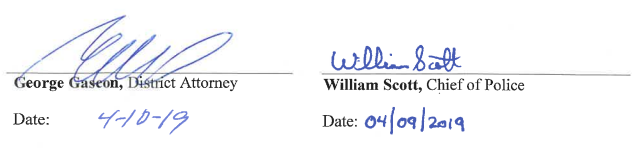
IN WITNESS WHEREOF, the parties hereto have executed this MOU as indicated below.