
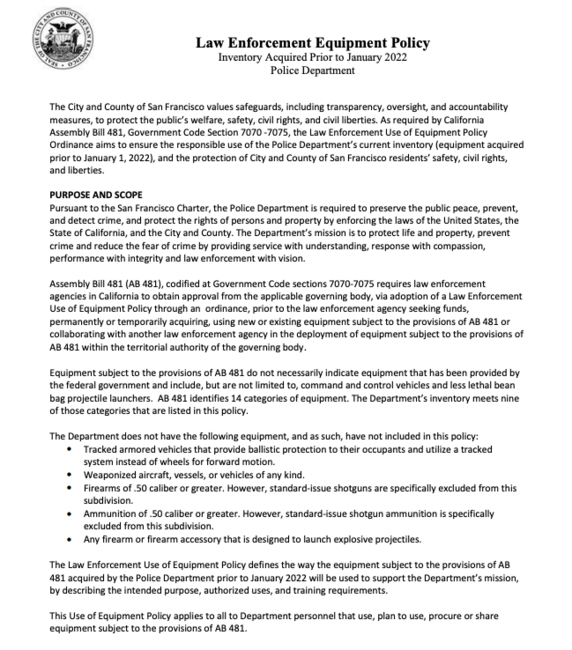
Law Enforcement Equipment Policy
Inventory Acquired Prior to January 2022 | Police Department
The City and County of San Francisco values safeguards, including transparency, oversight, and accountability measures, to protect the public’s welfare, safety, civil rights, and civil liberties. As required by California Assembly Bill 481, Government Code Section 7070 -7075, the Law Enforcement Use of Equipment Policy Ordinance aims to ensure the responsible use of the Police Department’s current inventory (equipment acquired prior to January 1, 2022), and the protection of City and County of San Francisco residents’ safety, civil rights, and liberties.
PURPOSE AND SCOPE
Pursuant to the San Francisco Charter, the Police Department is required to preserve the public peace, prevent, and detect crime, and protect the rights of persons and property by enforcing the laws of the United States, the State of California, and the City and County. The Department’s mission is to protect life and property, prevent crime and reduce the fear of crime by providing service with understanding, response with compassion, performance with integrity and law enforcement with vision.
Assembly Bill 481 (AB 481), codified at Government Code sections 7070-7075 requires law enforcement agencies in California to obtain approval from the applicable governing body, via adoption of a Law Enforcement Use of Equipment Policy through an ordinance, prior to the law enforcement agency seeking funds, permanently or temporarily acquiring, using new or existing equipment subject to the provisions of AB 481 or collaborating with another law enforcement agency in the deployment of equipment subject to the provisions of AB 481 within the territorial authority of the governing body.
Equipment subject to the provisions of AB 481 do not necessarily indicate equipment that has been provided by the federal government and include, but are not limited to, command and control vehicles and less lethal bean bag projectile launchers. AB 481 identifies 14 categories of equipment. The Department’s inventory meets nine of those categories that are listed in this policy.
The Department does not have the following equipment, and as such, have not included in this policy:
- Tracked armored vehicles that provide ballistic protection to their occupants and utilize a tracked system instead of wheels for forward motion.
- Weaponized aircraft, vessels, or vehicles of any kind.
- Firearms of .50 caliber or greater. However, standard-issue shotguns are specifically excluded from this subdivision.
- Ammunition of .50 caliber or greater. However, standard-issue shotgun ammunition is specifically excluded from this subdivision.
- Any firearm or firearm accessory that is designed to launch explosive projectiles.
The Law Enforcement Use of Equipment Policy defines the way the equipment subject to the provisions of AB 481 acquired by the Police Department prior to January 2022 will be used to support the Department’s mission, by describing the intended purpose, authorized uses, and training requirements.
This Use of Equipment Policy applies to all to Department personnel that use, plan to use, procure or share equipment subject to the provisions of AB 481.
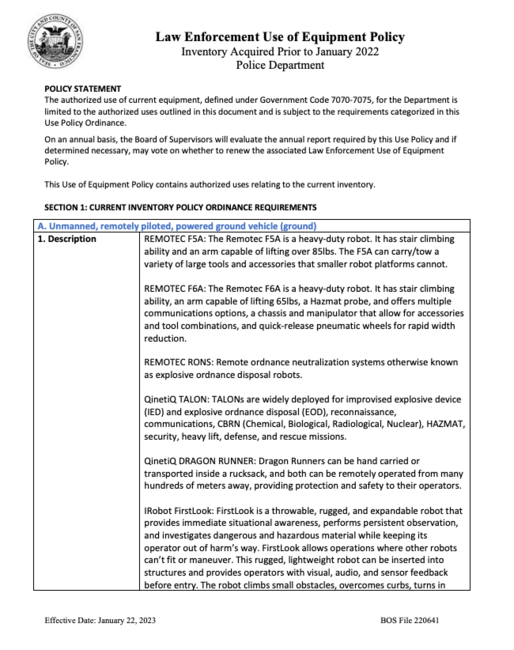
POLICY STATEMENT
The authorized use of current equipment, defined under Government Code 7070-7075, for the Department is limited to the authorized uses outlined in this document and is subject to the requirements categorized in this Use Policy Ordinance.
On an annual basis, the Board of Supervisors will evaluate the annual report required by this Use Policy and if determined necessary, may vote on whether to renew the associated Law Enforcement Use of Equipment Policy.
This Use of Equipment Policy contains authorized uses relating to the current inventory.
SECTION 1: CURRENT INVENTORY POLICY ORDINANCE REQUIREMENTS
- Unmanned, remotely piloted, powered ground vehicle (ground)
Description
REMOTEC F5A: The Remotec F5A is a heavy-duty robot. It has stair climbing ability and an arm capable of lifting over 85lbs. The F5A can carry/tow a variety of large tools and accessories that smaller robot platforms cannot.REMOTEC F6A: The Remotec F6A is a heavy-duty robot. It has stair climbing ability, an arm capable of lifting 65lbs, a Hazmat probe, and offers multiple communications options, a chassis and manipulator that allow for accessories and tool combinations, and quick-release pneumatic wheels for rapid width reduction.
REMOTEC RONS: Remote ordnance neutralization systems otherwise known as explosive ordnance disposal robots.
QinetiQ TALON: TALONs are widely deployed for improvised explosive device (IED) and explosive ordnance disposal (EOD), reconnaissance, communications, CBRN (Chemical, Biological, Radiological, Nuclear), HAZMAT, security, heavy lift, defense, and rescue missions.
QinetiQ DRAGON RUNNER: Dragon Runners can be hand carried or transported inside a rucksack, and both can be remotely operated from many hundreds of meters away, providing protection and safety to their operators.
IRobot FirstLook: FirstLook is a throwable, rugged, and expandable robot that provides immediate situational awareness, performs persistent observation, and investigates dangerous and hazardous material while keeping its operator out of harm’s way. FirstLook allows operations where other robots can’t fit or maneuver. This rugged, lightweight robot can be inserted into structures and provides operators with visual, audio, and sensor feedback before entry. The robot climbs small obstacles, overcomes curbs, turns in place and self-rights when flipped over.
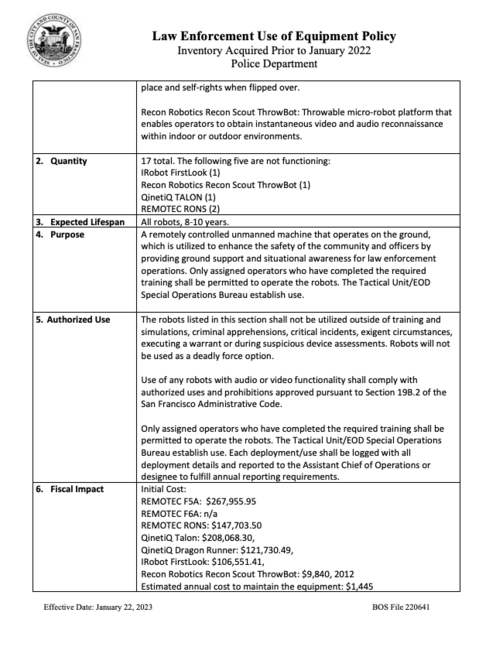
Recon Robotics Recon Scout ThrowBot: Throwable micro-robot platform that enables operators to obtain instantaneous video and audio reconnaissance within indoor or outdoor environments.
- Quantity
17 total. The following five are not functioning:
IRobot FirstLook (1)
Recon Robotics Recon Scout ThrowBot (1)
QinetiQ TALON (1)
REMOTEC RONS (2)
- Expected Lifespan
All robots, 8-10 years.
- Purpose
A remotely controlled unmanned machine that operates on the ground, which is utilized to enhance the safety of the community and officers by providing ground support and situational awareness for law enforcement operations. Only assigned operators who have completed the required training shall be permitted to operate the robots. The Tactical Unit/EOD Special Operations Bureau establish use.
Authorized Use
The robots listed in this section shall not be utilized outside of training and simulations, criminal apprehensions, critical incidents, exigent circumstances, executing a warrant or during suspicious device assessments. Robots will not be used as a deadly force option.Use of any robots with audio or video functionality shall comply with authorized uses and prohibitions approved pursuant to Section 19B.2 of the San Francisco Administrative Code.
Only assigned operators who have completed the required training shall be permitted to operate the robots. The Tactical Unit/EOD Special Operations Bureau establish use. Each deployment/use shall be logged with all deployment details and reported to the Assistant Chief of Operations or designee to fulfill annual reporting requirements.
- Fiscal Impact
Initial Cost:
REMOTEC F5A: $267,955.95 REMOTEC F6A: n/a
REMOTEC RONS: $147,703.50
QinetiQ Talon: $208,068.30,
QinetiQ Dragon Runner: $121,730.49, IRobot FirstLook: $106,551.41,
Recon Robotics Recon Scout ThrowBot: $9,840, 2012
Estimated annual cost to maintain the equipment: $1,445
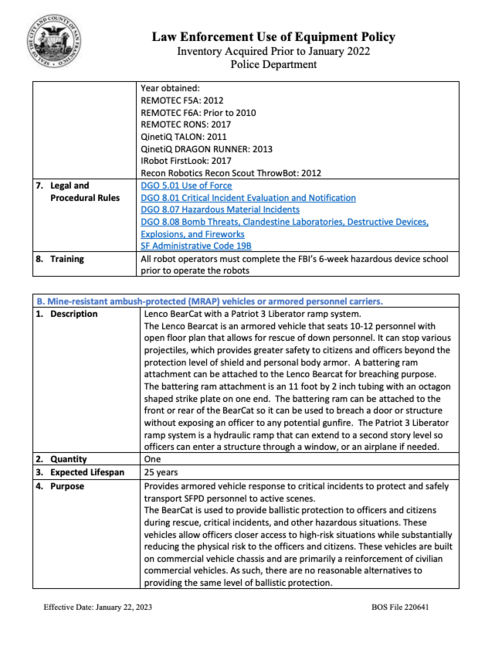
Year obtained:
REMOTEC F5A: 2012 REMOTEC F6A: Prior to 2010 REMOTEC RONS: 2017
QinetiQ TALON: 2011
QinetiQ DRAGON RUNNER: 2013
IRobot FirstLook: 2017
Recon Robotics Recon Scout ThrowBot: 2012
- Legal and Procedural Rules
DGO 5.01 Use of Force
DGO 8.01 Critical Incident Evaluation and Notification
DGO 8.07 Hazardous Material Incidents
DGO 8.08 Bomb Threats, Clandestine Laboratories, Destructive Devices, Explosions, and Fireworks
SF Administrative Code 19B
- Training
All robot operators must complete the FBI’s 6-week hazardous device school prior to operate the robots
- Mine-resistant ambush-protected (MRAP) vehicles or armored personnel carriers.
- Description
Lenco BearCat with a Patriot 3 Liberator ramp system.
The Lenco Bearcat is an armored vehicle that seats 10-12 personnel with open floor plan that allows for rescue of down personnel. It can stop various projectiles, which provides greater safety to citizens and officers beyond the protection level of shield and personal body armor. A battering ram attachment can be attached to the Lenco Bearcat for breaching purpose. The battering ram attachment is an 11 foot by 2 inch tubing with an octagon shaped strike plate on one end. The battering ram can be attached to the front or rear of the BearCat so it can be used to breach a door or structure without exposing an officer to any potential gunfire. The Patriot 3 Liberator ramp system is a hydraulic ramp that can extend to a second story level so officers can enter a structure through a window, or an airplane if needed.
- Quantity
One
- Expected Lifespan
25 years
- Purpose
Provides armored vehicle response to critical incidents to protect and safely transport SFPD personnel to active scenes.
The BearCat is used to provide ballistic protection to officers and citizens during rescue, critical incidents, and other hazardous situations. These vehicles allow officers closer access to high-risk situations while substantially reducing the physical risk to the officers and citizens. These vehicles are built on commercial vehicle chassis and are primarily a reinforcement of civilian commercial vehicles. As such, there are no reasonable alternatives to providing the same level of ballistic protection.
- Authorized Use
To protect and safely transport SFPD personnel to active scenes. Used only by Tactical and Specialist Teams when authorized by commissioned officers for:- mobile physical cover in incidents involving actual or threatened violence or when reasonable suspicion, based on articulable facts, exists that violence will occur using firearms or explosives; or any deadly weapon;
- Vehicle blocking for incidents involving armed and unresponsive persons in vehicles;
- Medical emergencies and disaster responses, when the armored vehicle’s capabilities are necessary to prevent loss of life.
Fiscal Impact
Initial Cost: $335,782.14
Estimated annual cost to maintain the equipment: $1,040Year obtained: 2010
- Legal and Procedural Rules
DGO 8.01 Critical Incident Evaluation and Notification
Training
Class C California Driver’s LicenseTactical Officer and Specialist Team Officer is trained in a 10-hour block to drive and operate the BearCat and ramp system and then trained annually, thereafter
- Description
- High mobility multipurpose wheeled vehicles (HMMWV), commonly referred to as Humvees, two and one-half-ton trucks, five-ton trucks, or wheeled vehicles that have a breaching or entry apparatus attached.
- Description
Lenco BearCat with a Patriot 3 Liberator ramp system (entry apparatus) and battering ram attachment.
See Section B1 for description.
- Quantity
One (listed in section B)
- Expected Lifespan
25 years
- Purpose
Provides armored vehicle response to critical incidents.
The BearCat is used to provide ballistic protection to officers and citizens during rescue, critical incidents, and other hazardous situations. These vehicles allow officers closer access to high-risk situations while substantially reducing the physical risk to the officers and citizens. These vehicles are built on commercial vehicle chassis and are primarily a reinforcement of civilian commercial vehicles. As such, there are no reasonable alternatives to providing the same level of ballistic protection. The battering ram attachment is an 11 foot by 2-inch tubing with an octagon shaped strike plate on one end. The battering ram can be attached to the front or rear of the BearCat so it can be used to breach a door or structure without exposing an officer to any potential gunfire.
Authorized Use
Entry apparatus on the BearCat may be used to allow personnel to enter or extract victims or suspects.Authorized to be used in high-risk tactical situations where de-escalation methods were unsuccessful, have been exhausted or where other force options would jeopardize the safety of the public and officers. Used by Tactical and Specialist Teams
See comments in Bear Cat, above.
Fiscal Impact
Initial Cost: $335,782.14
Estimated annual cost to maintain the equipment: $1,040Year obtained: 2010
- Legal and Procedural Rules
DGO 8.01 Critical Incident Evaluation and Notification
- Training
Class C California Driver’s License
Tactical Officer and Specialist Team Officer is trained in a 10-hour block to drive and operate the BearCat and ramp system and then trained annually, thereafter
- Description
- Command and control vehicles that are either built or modified to facilitate the operational control and direction of public safety units.
- Description
Ford Eagle Motor Home (MH)
Ford Eagle Motor Home (MH)
Ford E-350 Van
Freightliner MT55 Cargo Van
Freightliner Sprinter Van
- Quantity
5 total
- Expected Lifespan
20 years
- Purpose
The mobile incident command vehicle is an unarmored vehicle equivalent to a commercial recreational vehicle. It is equipped with specific communication and audio-visual devices to assist in command and control of a critical incident. This vehicle allows for mobile incident command and use of the Incident Command Systems facilitating the best possible on scene decision-making by key leaders. It provides for mobility, sheltering, and logistical support, restroom facilities and power.
There is no known alternative for the Mobile Incident Command Vehicles which provide the same amount of mobility and support at one location in a quick deploying package.
- Authorized Use
To be used at both planned and unplanned events including critical incidents, large demonstrations, or prolonged incidents where an on-scene command post would help the outcome of the incident.
The Homeland Security Unit (HSU) maintains a fleet of five command vans. The on-scene Incident commander determines the need for a command vehicle.
Fiscal Impact
Initial Cost: $3,500,000
Estimated annual cost to maintain the equipment: ~$50,000Year obtained:
Ford Eagle MH, 2001
Ford Eagle MH, 2002
Ford E-350 Van, 1992
Freightliner MT-55, 2012
Freightliner Sprinter Van, 2011
- Legal and Procedural Rules
Department Notice 21-128 Command Van Requests
DGO 8.01 Critical Incident Evaluation and Notification
SFPD Crowd Control Manual
- Training
Freightliner: Class B license
Remaining Command Vehicles require Class C license.
The National Incident Management System Training Program: Incident Command System (ICS) 100-800
ICS 300 & 400
Emergency Vehicle Operator Course (EVOC)
- Description
- Battering rams, slugs, and breaching apparatuses that are explosive in nature
- Description
Energetic Breaching Tool
Kinetic Breaching Tool
Ballistic Breacher Rounds
Pan Disrupter (attached to a robot)
- Quantity
Energetic Breaching Tool: Detonating Cord: 18 grain per foot - 2.3 lbs., 25 grain per foot - 12.1 lbs., 50 grain per foot – 6.2 lbs., 100 grain per foot – 0.4 lbs., and 200 grain per foot – 1.4 lbs.; Blasting Caps: 17 Units; Materials: UTK Rubber Strips – 33 pieces, UTK Pucks – 11 pieces, FETT Rubber Rolls – 5 rolls, Fett Water Bladders – 40 pieces, Hydro Gel Rolls – 20 rolls, and Breacher Tape – 20 rolls.
Kinetic Breaching Tool: 3
Ballistic Breacher Rounds: 200 rounds
Pan Disrupter (attached to a robot): 2 Units
- Expected Lifespan
5 Years Purpose
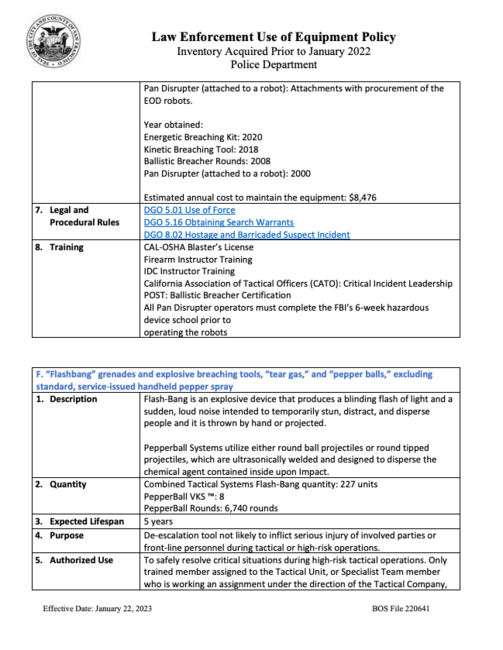
Used to safely breach doors or devices.
This allows officers to conduct rescues or high-risk forceable entries during high risk and critical incidents. These items allow peace officers to quickly and safely enter a structure when time is of the essence and where it is not feasible to delay access to the structure. The alternative to these items may involve mechanical breaching which requires officers to stand in front of the door utilizing hydraulic tools, rams, sledgehammers, the jaws of life or other handheld battering rams. This increases the likelihood of the use of Department issued firearms if suspects fire upon officers that are in a doorway utilizing a handheld battering ram. As such there is no reasonable alternative to these items listed in this category if negotiation, or de- escalation or other alternatives to entry are not possible.Law enforcement agencies receive calls for suspicious packages every day. SFPD's Explosive Ordnance Detail (EOD) AKA bomb squad, is responsible for performing the threat assessment of these suspicious packages. These packages can be an improvised explosive device (IED) which has no standard application, meaning there is no one standard way to address these devices. IEDs are homemade and are becoming more sophisticated as web/internet resources are more readily available. SFPD has tools that minimize the time on target (the amount of time an officer is next to a suspicious package/device) and provide more protection for our bomb techs, which in turn provides increased safety for the public. One of these tools is a “pan disruptor” and can be attached to a wheeled robot. The pan disrupter is a percussion actuated non-electrically fired device. It is a steel tube filled with water, plugged off on one side while the other side is capped by a shotgun shell. A breach is used which has a firing pin that is projected forward by an explosively driven shock wave from a shock tube- this is fired remotely so the bomb tech does not have to be anywhere near the package as it is breached.
- Authorized Use
For use during high-risk warrant service on fortified locations, encounters with barricaded suspects, active shooter, and hostage rescue.
Fiscal Impact
Initial cost:
Energetic Breaching Kit: $5,000
Kinetic Breaching Tool: $9,500 per unit Ballistic Breacher Rounds: $150 for 25 rounds
Pan Disrupter (attached to a robot): Attachments with procurement of the EOD robots.Year obtained:
Energetic Breaching Kit: 2020
Kinetic Breaching Tool: 2018
Ballistic Breacher Rounds: 2008
Pan Disrupter (attached to a robot): 2000Estimated annual cost to maintain the equipment: $8,476
- Legal and Procedural Rules
DGO 5.01 Use of Force
DGO 5.16 Obtaining Search Warrants
DGO 8.02 Hostage and Barricaded Suspect Incident
- Training
CAL-OSHA Blaster’s License
Firearm Instructor Training
IDC Instructor Training
California Association of Tactical Officers (CATO): Critical Incident Leadership
POST: Ballistic Breacher Certification
All Pan Disrupter operators must complete the FBI’s 6-week hazardous
device school prior to
operating the robots
- Description
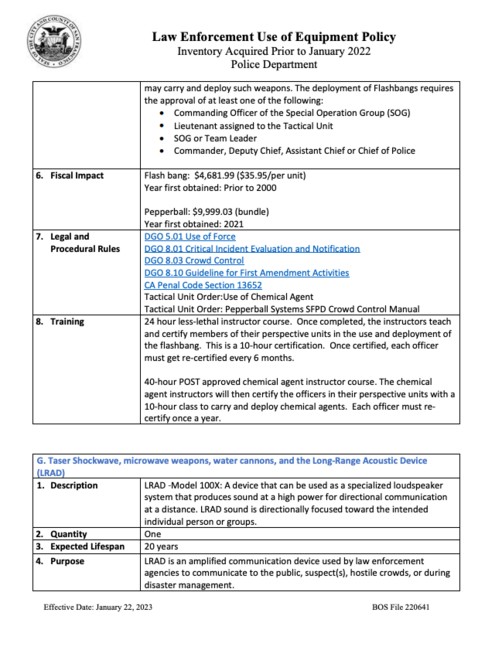
- “Flashbang” grenades and explosive breaching tools, “tear gas,” and “pepper balls,” excluding standard, service-issued handheld pepper spray
Description
Flash-Bang is an explosive device that produces a blinding flash of light and a sudden, loud noise intended to temporarily stun, distract, and disperse people and it is thrown by hand or projected.Pepperball Systems utilize either round ball projectiles or round tipped projectiles, which are ultrasonically welded and designed to disperse the chemical agent contained inside upon Impact.
- Quantity
Combined Tactical Systems Flash-Bang quantity: 227 units
PepperBall VKS ™: 8
PepperBall Rounds: 6,740 rounds
- Expected Lifespan
5 years
- Purpose
De-escalation tool not likely to inflict serious injury of involved parties or front-line personnel during tactical or high-risk operations.
- Authorized Use
To safely resolve critical situations during high-risk tactical operations. Only trained member assigned to the Tactical Unit, or Specialist Team member who is working an assignment under the direction of the Tactical Company, may carry and deploy such weapons. The deployment of Flashbangs requires the approval of at least one of the following:- Commanding Officer of the Special Operation Group (SOG)
- Lieutenant assigned to the Tactical Unit
- SOG or Team Leader
- Commander, Deputy Chief, Assistant Chief or Chief of Police
Fiscal Impact
Flash bang: $4,681.99 ($35.95/per unit) Year first obtained: Prior to 2000Pepperball: $9,999.03 (bundle) Year first obtained: 2021
- Legal and Procedural Rules
DGO 5.01 Use of Force
DGO 8.01 Critical Incident Evaluation and Notification
DGO 8.03 Crowd Control
DGO 8.10 Guideline for First Amendment Activities
CA Penal Code Section 13652
Tactical Unit Order:Use of Chemical Agent
Tactical Unit Order: Pepperball Systems SFPD Crowd Control Manual
Training
24 hour less-lethal instructor course. Once completed, the instructors teach and certify members of their perspective units in the use and deployment of the flashbang. This is a 10-hour certification. Once certified, each officer must get re-certified every 6 months.40-hour POST approved chemical agent instructor course. The chemical agent instructors will then certify the officers in their perspective units with a 10-hour class to carry and deploy chemical agents. Each officer must re- certify once a year.
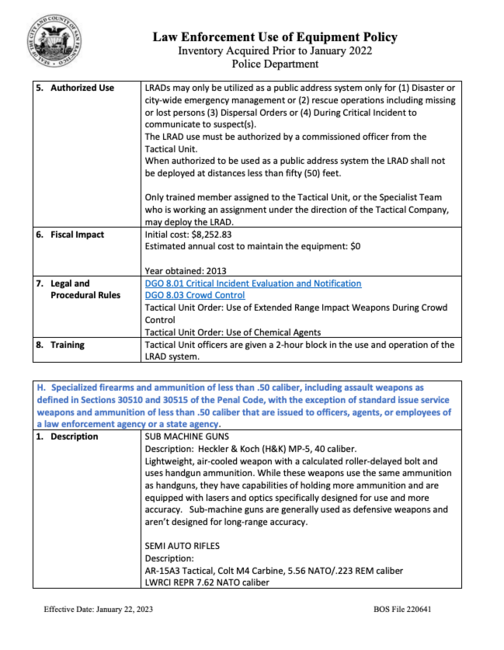
- Taser Shockwave, microwave weapons, water cannons, and the Long-Range Acoustic Device (LRAD)
- Description
LRAD -Model 100X: A device that can be used as a specialized loudspeaker system that produces sound at a high power for directional communication at a distance. LRAD sound is directionally focused toward the intended individual person or groups.
- Quantity
One
- Expected Lifespan
20 years
- Purpose
LRAD is an amplified communication device used by law enforcement agencies to communicate to the public, suspect(s), hostile crowds, or during disaster management.
Authorized Use
LRADs may only be utilized as a public address system only for (1) Disaster or city-wide emergency management or (2) rescue operations including missing or lost persons (3) Dispersal Orders or (4) During Critical Incident to communicate to suspect(s).
The LRAD use must be authorized by a commissioned officer from the Tactical Unit.
When authorized to be used as a public address system the LRAD shall not be deployed at distances less than fifty (50) feet.Only trained member assigned to the Tactical Unit, or the Specialist Team who is working an assignment under the direction of the Tactical Company, may deploy the LRAD.
Fiscal Impact
Initial cost: $8,252.83
Estimated annual cost to maintain the equipment: $0Year obtained: 2013
- Legal and Procedural Rules
DGO 8.01 Critical Incident Evaluation and Notification
DGO 8.03 Crowd Control
Tactical Unit Order: Use of Extended Range Impact Weapons During Crowd Control
Tactical Unit Order: Use of Chemical Agents
- Training
Tactical Unit officers are given a 2-hour block in the use and operation of the LRAD system.
- Description
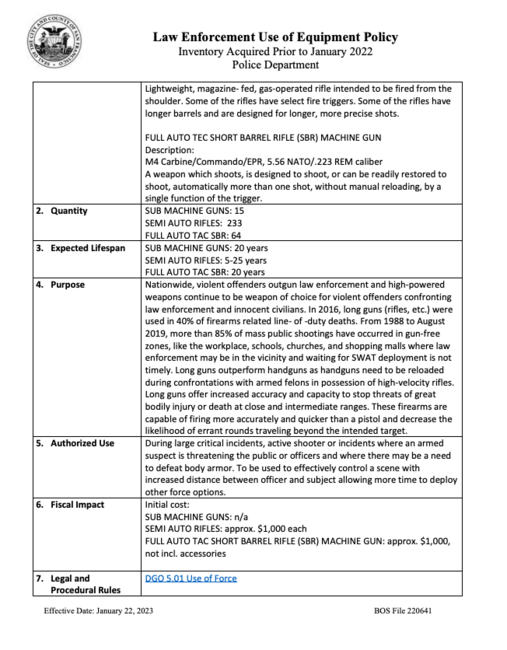
- Specialized firearms and ammunition of less than .50 caliber, including assault weapons as defined in Sections 30510 and 30515 of the Penal Code, with the exception of standard issue service weapons and ammunition of less than .50 caliber that are issued to officers, agents, or employees of a law enforcement agency or a state agency.
Description
SUB MACHINE GUNS
Description: Heckler & Koch (H&K) MP-5, 40 caliber.
Lightweight, air-cooled weapon with a calculated roller-delayed bolt and uses handgun ammunition. While these weapons use the same ammunition as handguns, they have capabilities of holding more ammunition and are equipped with lasers and optics specifically designed for use and more accuracy. Sub-machine guns are generally used as defensive weapons and aren’t designed for long-range accuracy.SEMI AUTO RIFLES
Description:
AR-15A3 Tactical, Colt M4 Carbine, 5.56 NATO/.223 REM caliber
LWRCI REPR 7.62 NATO caliber
Lightweight, magazine- fed, gas-operated rifle intended to be fired from the shoulder. Some of the rifles have select fire triggers. Some of the rifles have longer barrels and are designed for longer, more precise shots.FULL AUTO TEC SHORT BARREL RIFLE (SBR) MACHINE GUN
Description:
M4 Carbine/Commando/EPR, 5.56 NATO/.223 REM caliber
A weapon which shoots, is designed to shoot, or can be readily restored to shoot, automatically more than one shot, without manual reloading, by a single function of the trigger.
- Quantity
SUB MACHINE GUNS: 15
SEMI AUTO RIFLES: 233
FULL AUTO TAC SBR: 64
- Expected Lifespan
SUB MACHINE GUNS: 20 years
SEMI AUTO RIFLES: 5-25 years
FULL AUTO TAC SBR: 20 years
- Purpose
Nationwide, violent offenders outgun law enforcement and high-powered weapons continue to be weapon of choice for violent offenders confronting law enforcement and innocent civilians. In 2016, long guns (rifles, etc.) were used in 40% of firearms related line- of -duty deaths. From 1988 to August 2019, more than 85% of mass public shootings have occurred in gun-free zones, like the workplace, schools, churches, and shopping malls where law enforcement may be in the vicinity and waiting for SWAT deployment is not timely. Long guns outperform handguns as handguns need to be reloaded during confrontations with armed felons in possession of high-velocity rifles. Long guns offer increased accuracy and capacity to stop threats of great bodily injury or death at close and intermediate ranges. These firearms are capable of firing more accurately and quicker than a pistol and decrease the likelihood of errant rounds traveling beyond the intended target.
- Authorized Use
Initial cost:
SUB MACHINE GUNS: n/a
SEMI AUTO RIFLES: approx. $1,000 each
FULL AUTO TAC SHORT BARREL RIFLE (SBR) MACHINE GUN: approx. $1,000, not incl. accessories
- Fiscal Impact
Initial cost:
SUB MACHINE GUNS: n/a
SEMI AUTO RIFLES: approx. $1,000 each
FULL AUTO TAC SHORT BARREL RIFLE (SBR) MACHINE GUN: approx. $1,000, not incl. accessories
- Legal and Procedural Rules
DGO 5.01 Use of Force
- Training
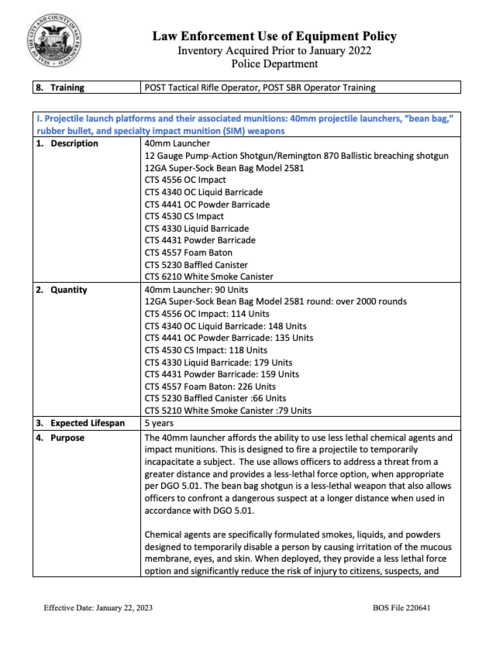
POST Tactical Rifle Operator, POST SBR Operator Training
- Projectile launch platforms and their associated munitions: 40mm projectile launchers, “bean bag,” rubber bullet, and specialty impact munition (SIM) weapons
- Description
40mm Launcher
12 Gauge Pump-Action Shotgun/Remington 870 Ballistic breaching shotgun
12GA Super-Sock Bean Bag Model 2581
CTS 4556 OC Impact
CTS 4340 OC Liquid Barricade
CTS 4441 OC Powder Barricade
CTS 4530 CS Impact
CTS 4330 Liquid Barricade
CTS 4431 Powder Barricade
CTS 4557 Foam Baton
CTS 5230 Baffled Canister
CTS 6210 White Smoke Canister
- Quantity
40mm Launcher: 90 Units
12GA Super-Sock Bean Bag Model 2581 round: over 2000 rounds
CTS 4556 OC Impact: 114 Units
CTS 4340 OC Liquid Barricade: 148 Units
CTS 4441 OC Powder Barricade: 135 Units
CTS 4530 CS Impact: 118 Units
CTS 4330 Liquid Barricade: 179 Units
CTS 4431 Powder Barricade: 159 Units
CTS 4557 Foam Baton: 226 Units
CTS 5230 Baffled Canister :66 Units
CTS 5210 White Smoke Canister :79 Units
- Expected Lifespan
5 years
Purpose
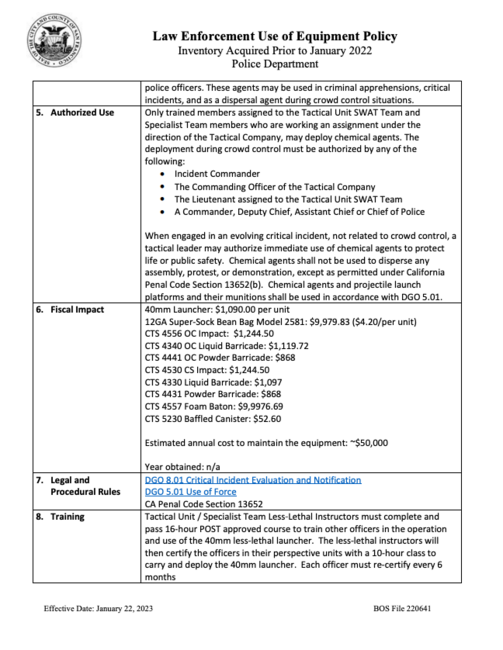
The 40mm launcher affords the ability to use less lethal chemical agents and impact munitions. This is designed to fire a projectile to temporarily incapacitate a subject. The use allows officers to address a threat from a greater distance and provides a less-lethal force option, when appropriate per DGO 5.01. The bean bag shotgun is a less-lethal weapon that also allows officers to confront a dangerous suspect at a longer distance when used in accordance with DGO 5.01.Chemical agents are specifically formulated smokes, liquids, and powders designed to temporarily disable a person by causing irritation of the mucous membrane, eyes, and skin. When deployed, they provide a less lethal force option and significantly reduce the risk of injury to citizens, suspects, and police officers. These agents may be used in criminal apprehensions, critical incidents, and as a dispersal agent during crowd control situations.
Authorized Use
Only trained members assigned to the Tactical Unit SWAT Team and Specialist Team members who are working an assignment under the direction of the Tactical Company, may deploy chemical agents. The deployment during crowd control must be authorized by any of the following:- Incident Commander
- The Commanding Officer of the Tactical Company
- The Lieutenant assigned to the Tactical Unit SWAT Team
- A Commander, Deputy Chief, Assistant Chief or Chief of Police
When engaged in an evolving critical incident, not related to crowd control, a tactical leader may authorize immediate use of chemical agents to protect life or public safety. Chemical agents shall not be used to disperse any assembly, protest, or demonstration, except as permitted under California Penal Code Section 13652(b). Chemical agents and projectile launch platforms and their munitions shall be used in accordance with DGO 5.01.
Fiscal Impact
40mm Launcher: $1,090.00 per unit
12GA Super-Sock Bean Bag Model 2581: $9,979.83 ($4.20/per unit)
CTS 4556 OC Impact: $1,244.50
CTS 4340 OC Liquid Barricade: $1,119.72
CTS 4441 OC Powder Barricade: $868
CTS 4530 CS Impact: $1,244.50
CTS 4330 Liquid Barricade: $1,097
CTS 4431 Powder Barricade: $868
CTS 4557 Foam Baton: $9,9976.69
CTS 5230 Baffled Canister: $52.60Estimated annual cost to maintain the equipment: ~$50,000
Year obtained: n/a
- Legal and Procedural Rules
DGO 8.01 Critical Incident Evaluation and Notification
DGO 5.01 Use of Force
CA Penal Code Section 13652
- Training
Tactical Unit / Specialist Team Less-Lethal Instructors must complete and pass 16-hour POST approved course to train other officers in the operation and use of the 40mm less-lethal launcher. The less-lethal instructors will then certify the officers in their perspective units with a 10-hour class to carry and deploy the 40mm launcher. Each officer must re-certify every 6 months
- Description
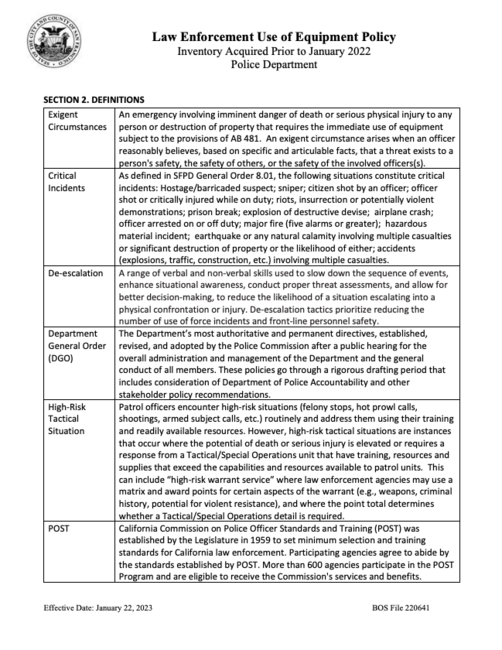
SECTION 2. DEFINITIONS
Exigent Circumstances
An emergency involving imminent danger of death or serious physical injury to any person or destruction of property that requires the immediate use of equipment subject to the provisions of AB 481. An exigent circumstance arises when an officer reasonably believes, based on specific and articulable facts, that a threat exists to a person's safety, the safety of others, or the safety of the involved officers(s).
Critical Incidents
As defined in SFPD General Order 8.01, the following situations constitute critical incidents: Hostage/barricaded suspect; sniper; citizen shot by an officer; officer shot or critically injured while on duty; riots, insurrection or potentially violent demonstrations; prison break; explosion of destructive devise; airplane crash; officer arrested on or off duty; major fire (five alarms or greater); hazardous material incident; earthquake or any natural calamity involving multiple casualties or significant destruction of property or the likelihood of either; accidents (explosions, traffic, construction, etc.) involving multiple casualties.
De-escalation
A range of verbal and non-verbal skills used to slow down the sequence of events, enhance situational awareness, conduct proper threat assessments, and allow for better decision-making, to reduce the likelihood of a situation escalating into a physical confrontation or injury. De-escalation tactics prioritize reducing the number of use of force incidents and front-line personnel safety.
Department General Order (DGO)
The Department’s most authoritative and permanent directives, established, revised, and adopted by the Police Commission after a public hearing for the overall administration and management of the Department and the general conduct of all members. These policies go through a rigorous drafting period that includes consideration of Department of Police Accountability and other stakeholder policy recommendations.
High-Risk Tactical Situation
Patrol officers encounter high-risk situations (felony stops, hot prowl calls, shootings, armed subject calls, etc.) routinely and address them using their training and readily available resources. However, high-risk tactical situations are instances that occur where the potential of death or serious injury is elevated or requires a response from a Tactical/Special Operations unit that have training, resources and supplies that exceed the capabilities and resources available to patrol units. This can include “high-risk warrant service” where law enforcement agencies may use a matrix and award points for certain aspects of the warrant (e.g., weapons, criminal history, potential for violent resistance), and where the point total determines whether a Tactical/Special Operations detail is required.
POST
California Commission on Police Officer Standards and Training (POST) was established by the Legislature in 1959 to set minimum selection and training standards for California law enforcement. Participating agencies agree to abide by the standards established by POST. More than 600 agencies participate in the POST Program and are eligible to receive the Commission's services and benefits.
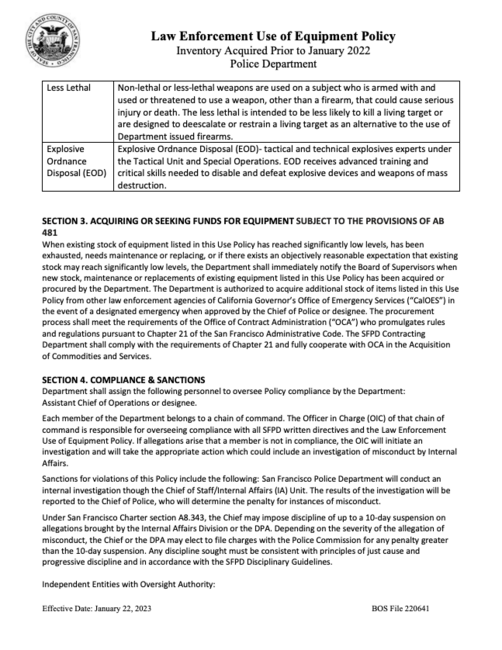
Less Lethal
Non-lethal or less-lethal weapons are used on a subject who is armed with and used or threatened to use a weapon, other than a firearm, that could cause serious injury or death. The less lethal is intended to be less likely to kill a living target or are designed to deescalate or restrain a living target as an alternative to the use of Department issued firearms.
Explosive Ordnance Disposal (EOD)
Explosive Ordnance Disposal (EOD)- tactical and technical explosives experts under the Tactical Unit and Special Operations. EOD receives advanced training and critical skills needed to disable and defeat explosive devices and weapons of mass destruction.
SECTION 3. ACQUIRING OR SEEKING FUNDS FOR EQUIPMENT SUBJECT TO THE PROVISIONS OF AB 481
When existing stock of equipment listed in this Use Policy has reached significantly low levels, has been exhausted, needs maintenance or replacing, or if there exists an objectively reasonable expectation that existing stock may reach significantly low levels, the Department shall immediately notify the Board of Supervisors when new stock, maintenance or replacements of existing equipment listed in this Use Policy has been acquired or procured by the Department. The Department is authorized to acquire additional stock of items listed in this Use Policy from other law enforcement agencies of California Governor’s Office of Emergency Services (“CalOES”) in the event of a designated emergency when approved by the Chief of Police or designee. The procurement process shall meet the requirements of the Office of Contract Administration (“OCA”) who promulgates rules and regulations pursuant to Chapter 21 of the San Francisco Administrative Code. The SFPD Contracting Department shall comply with the requirements of Chapter 21 and fully cooperate with OCA in the Acquisition of Commodities and Services.
SECTION 4. COMPLIANCE & SANCTIONS
Department shall assign the following personnel to oversee Policy compliance by the Department: Assistant Chief of Operations or designee.
Each member of the Department belongs to a chain of command. The Officer in Charge (OIC) of that chain of command is responsible for overseeing compliance with all SFPD written directives and the Law Enforcement Use of Equipment Policy. If allegations arise that a member is not in compliance, the OIC will initiate an investigation and will take the appropriate action which could include an investigation of misconduct by Internal Affairs.
Sanctions for violations of this Policy include the following: San Francisco Police Department will conduct an internal investigation though the Chief of Staff/Internal Affairs (IA) Unit. The results of the investigation will be reported to the Chief of Police, who will determine the penalty for instances of misconduct.
Under San Francisco Charter section A8.343, the Chief may impose discipline of up to a 10-day suspension on allegations brought by the Internal Affairs Division or the DPA. Depending on the severity of the allegation of misconduct, the Chief or the DPA may elect to file charges with the Police Commission for any penalty greater than the 10-day suspension. Any discipline sought must be consistent with principles of just cause and progressive discipline and in accordance with the SFPD Disciplinary Guidelines.
Independent Entities with Oversight Authority:
Pursuant to the San Francisco Charter section 4109, the Police Commission is empowered to prescribe and enforce any reasonable rules and regulations that it deems necessary to provide for the efficiency of the Department, provided that the civil service and ethics provisions of this Charter shall control in the event of any conflict with rules adopted under section 4109.
Under San Francisco Charter section 4.136(k), the Department of Police Accountability shall conduct a performance audit or review of police officer use of force and how the Police Department has handled claims of officer misconduct. DPA shall also have the authority to conduct performance audits or reviews of whether Police Department personnel and management have complied with federal and state law, City ordinances and policies, and Police Department policies.
Complaints of Officer Misconduct: Members of the public can register complaints about SFPD activities with the Department of Police Accountability (DPA), 1 South Van Ness Ave, 8th Floor, San Francisco, CA 94103, (415) 241-7711. DPA, by Charter authority, receives and manages all citizen complaints relating to SFPD use of force, misconduct, or allegations that a member has not properly performed a duty. DPA manages, acknowledges, and responds to complaints from members of the public.
Complaints, Concerns, and Inquiries: Department shall acknowledge and respond to concerns in a timely and manner. To do so, the Department has included a Law Enforcement Use of Equipment Policy page on its public website. This page includes an email address for public inquiries: [email protected]. This email is assigned to multiple staff members in the Chief's Office who will respond to inquiries within 48 hours.
SECTION 5: COLLABORATION WITH OUTSIDE LAW ENFORCEMENT AGENCIES
Equipment not listed in this Law Enforcement Use of Equipment Policy shall not be used by any other law enforcement agency or member in this jurisdiction unless there is an approved interagency operation in compliance with SFPD DGO 5.14, an exigent circumstance requiring deployment of mutual aid partners , SFPD members have made the law enforcement agency aware of this Use Policy or the equipment subject to the provisions of AB 481 is approved for use in accordance with this policy.
SECTION 6: ANNUAL REPORTING
Pursuant to Ca. Gov Code Section 7072, the San Francisco Police Department shall submit an annual Law Enforcement Use of Equipment report to the Board of Supervisors. The annual submission shall report on each type of equipment approved by the Board of Supervisors within one year of approval, and annually thereafter for as long as the equipment is available for use. The annual Law Enforcement Use of Equipment report shall, at a minimum, include the following information for the immediately preceding calendar year for each type of equipment subject to the provisions of AB 481.
- A summary of how the equipment was used, which equipment was used, the frequency of use, the purpose of its use, and the outcome of the incident, including whether injuries were sustained.
- A summary of any complaints or concerns received concerning the equipment.
- The results of any internal audits, any information about violations of the equipment use policy, and any actions taken in response.
- The total annual cost for each type of equipment, including acquisition, personnel, training, transportation, maintenance, storage, upgrade, and other ongoing costs, and from what source funds will be provided for the equipment in the calendar year following submission of the annual equipment report.
- The quantity possessed for each type of equipment subject to the provisions of AB 481.
- If SFPD intends to acquire additional equipment subject to the provisions of AB 481 in the next year, the quantity sought for each type of equipment.
Each deployment/use shall be logged with all deployment details and reported to the Assistant Chief of Operations or designee to fulfill annual reporting requirements.
Within 30 days of submitting and publicly releasing an annual Law Enforcement Use of Equipment report, SFPD shall hold at least one well-publicized and conveniently located community meeting through the Police Commission at which the general public may discuss and ask questions regarding the annual Law Enforcement Use of Equipment report and SFPD’s funding, acquisition, or use of equipment listed in the report.
The Board of Supervisors shall determine, based on review of the annual report, whether each type of equipment identified in this use policy complied with the standards set forth in Government Code 7071(d). If the Board of Supervisors determines that SFPD has not complied with Government Code 7071(d) standards, they may vote to disapprove a renewal or require modifications to this use policy in a manner that will resolve the lack of SFPD’s compliance with Government Code 7071(d).
The annual Law Enforcement Use of Equipment report shall be made publicly available on SFPD’s website for as long as the equipment subject to the provisions of AB 481 is available for use.
Effective Date: January 22, 2023
BOS File 220641