
Crisis Intervention Team (CIT) Liaison Program Training Guide
CIT LIAISON PROGRAM:
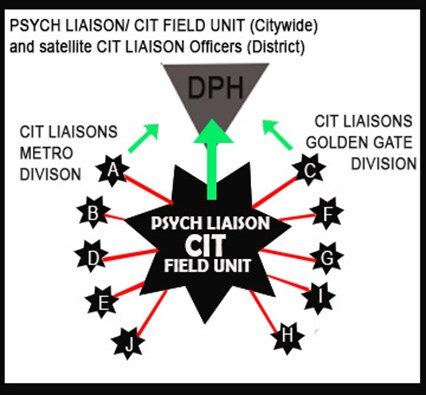
CONGRATULATIONS! You have been selected to be an official SFPD CIT Liaison for your District Station. Based on your interest in Crisis Intervention, training and experience, and excellent performance in the field of patrol, the CIT Unit recognizes you as a tremendous resource to our larger city wide operation. The CIT Liaison Program was created to maximize our department’s ability to identify and engage subjects who may present a danger to self and/or others, demonstrate behaviors.
As per Department General Order (DGO 5.21) all 10 District Stations throughout San Francisco are required to have designated ‘CIT Liaison Officers’ who specialize in matters pertaining to Crisis Intervention in their respective district.
Each designated CIT Liaison takes on the roles and responsibilities established in this course guide. The CIT Liaison position is an ancillary role, whereby members assigned ot patrol, help facilitate the larger goals of Crisis Intervention. Because the CIT Liaison program is rooted in patrol, it helps CIT identify and address the most concerning subjects, because patrol officers have valuable working knowledge and the most direct experience responding to crisis incidents.
DISTRICT STATION - CIT LIAISON OFFICERS 2025
- Each station has 2 CIT Liaison positions. Positions are occasionally vacated due to transfer, promotion and/or retirement and need to be filled.
- CIT Unit Contacts are listed as a direct resource to district CIT Liaisons. The CIT Unit contacts can provide an additional level fo support to the station regarding CIT-relate issues.
- Should CIT Liaisons be re-assigned or transferred, it is their responsibility to notify the CIT Unit so their assignment can be filled and stipend payment stopped.
- CIT Liaisons should respond in a timely manner to CIT related emails and inquiries specific to their assignment.
- CIT Liaisons should advise their contacts at the CIT Unit regarding crisis subject who require an additional engagement.
BAYVIEW Station: (415) 671-2300
Sgt. Joaquin Borromeo
Officer Eric G. Eastlund
(CIT Unit contact: Matt Nazar)
CENTRAL Station: (415) 315-2400
Officer Stephen Collins
Officer George Raymond
(CIT Unit contact: Chris Cotter)
MISSION Station: (415) 558-5400
Officer Justin Dombkowski
Officer Nathalie Peraza
(CIT Unit contact: John Ishida)
INGLESIDE Station: (415) 404-4000
Officer Tim Watts
Officer Anthony Bautista
(CIT Unit contact: Matt Nazar)
NORTHERN Station: (415) 614-3400
Officer Derek Brown
Officer Malia Dudum
(CIT Unit contact: Keith Murphy)
PARK Station: (415) 242-3000
Officer Stan Bratchikov
Officer Vaughn Lewis
(CIT Unit contact: John Ishida)
SOUTHERN Station: (415) 575-6027
Sgt. Brian Kneuker
Officer Edcel Suarez
(CIT Unit contact: Chris Cotter)
TENDERLOIN Station: (415) 345-7341
Sgt. George Luedtke
Officer Hillary King
(CIT Unit contact: Nick Zerga)
RICHMOND Station: (415) 666-8000
Sgt. Eric Mahoney
Officer Anna Cuthbertson
(CIT Unit contact: Keith Murphy)
TARAVAL Station: (415) 759 -3100
Sgt. Pavel Khmarskiy
Officer Matthew Hewitson
(CIT Unit contact: Nick Zerga)
OBJECTIVES:
The goal of the SFPD CIT Liaison Program is to purposefully expand the substantive structure of functional Crisis Intervention at the patrol level of law enforcement.
Given the extremely large volume of crisis-related incidents in San Francisco , it makes sense that all district stations are able to operate as functional satellites to the larger CIT Unit, so that intervention strategies are maximized and the most challenged and concerning subjects receive the appropriate attention and consideration. The CIT Liaison Program fortifies the San Francisco Police Department‘s ability to readily engage the multitude of complex and diverse of crisis-related incidents that unfold throughout the City’s 10 patrol districts every day. The CIT Liaison Program encourages each station to IDENTIFY, STRATEGICALLY ENGAGE, and NOTIFY CIT/CCS regarding crisis issues/subjects in their districts.
CIT Liaisons are encouraged to notify crisis specialists at DPH regarding appropriate services and referrals with the intent to help people and also circumvent routine and repeat patrol response.
With this CIT Liaison Program in place, patrol officers are able to help facilitate long-term strategies to ensure public safety and community wellbeing.
Background of Crisis Intervention Training:
40hr CIT Certification & 10-hr De-escalation/CIT Field Tactics
The SFPD CIT Unit is a small specialized unit that is primarily concerned with the safe and effective engagement of subjects in crisis. Given that San Francisco is a major metropolitan city, our depart-ment experiences a very high volume of calls for service that require some aspect of crisis intervention.
On December 21, 2016, the San Francisco Police Commission unanimously adopted San Francisco Police Department General Order 5.21, the Crisis Intervention Team Response to Person in Crisis Calls for Service. In addition to describing detailed SFPD CIT policies, training, procedures and administrative structure, the purpose of this DGO underscores the breadth of crisis-related work that police are dealing with across San Francisco by San Francisco Police. As such, The CIT Unit also conducts department wide training and certification courses in these CIT areas. Currently 72% of SFPD is trained in the 40-hr CIT Certification course and 100% of patrol is trained in the 10-hr CIT De-escalation and Field Tactics course.
CIT Liaisons are expected to be conversant in all levels of CIT-related training they have received.
CIT LIAISON ROLE: GENERAL RESPONSIBILITES
CIT LIAISON OFFICERS at District Stations conduct the following general CIT duties, coordinate information with CIT Field Unit, and utilize DPH services when feasible:
- MAINTAIN WORKING KNOWLEDGE of DISTRICT ISSUES: Maintain working knowledge of district concerns as they pertain to CIT. Know resources, services, frequent areas of concern.
- MAINTAIN CIT Board at District Station: Post relevant alerts, flyers, and CIT-related information.
- MAINTAIN WORKING KNOWLEDGE of CIT Practices and Principles: be cognizant of CIT Field Tactics, Intervention strategies, training issues, General Orders, and Department Notices.
- IDENTIFY DISTRICT’S CIT SUBJECTS: Have working knowledge of District’s most concerning subjects, as they pertain to CIT: (subjects frequently requiring a police response for behavioral issues related to mental health issues, subjects who appear to present a danger to self and/or others with access to weapons and who also may be suffering from mental health issues, gravely disabled subjects.)
- CONDUCT DE-BRIEFINGS for CIT incidents: When feasible, conduct informal debriefings with personnel at the conclusion of crisis incidents to determine positive and negative outcomes, with the intent of improving engagement and tactics.
- NOTIFICATIONS: Notify CIT Unit immediately regarding higher-risk subjects (weapons, history of violent crime.)
- CONTACT COMPREHENSIVE CRISIS SERVICES as needed and provide information regarding issues. DPH to coordinate outreach as needed. Contact info: (628) 217-7000
- DOCUMENT ACTIVITY: When appropriate, ensure incidents are documented in police reports and note CAD/CASE numbers.
- COMMUNICATE: Communicate issues with CIT Unit. Communicate with Comprehensive Crisis/DPH regarding subjects. (Such as: reports, criminal history, firearm prohibitions, registered firearms.) Respond to all CIT related communications in a timely manner.
- PROVIDE ON-SCENE SUPPORT for CIT Field VISITS: As needed, or when feasible.
- MEETINGS: Attend scheduled CIT Liaison team meetings when required.
- IMPLEMENT ROLL-CALL TRAINING: conduct roll-call training with patrol when needed
INCENTIVES for CIT LIAISON Officers at District Stations:
- Per pay-period compensation (i.e. Training Sergeant pay.)
- Utilization of invaluable institutional knowledge to help peers, patrol, and communities
- Access to career-development training: CIT, HNT, CIRT, Peer Support
- Build knowledge and make contacts for useful City Services (DPH, Mobile Crisis)
PARTNERSHIP WITH DPH:
COMPREHENSIVE CRISIS SPECIALISTS
With the Department of Public Health and DPH Crisis Specialists, the CIT Program is building partnerships to assist subjects in crisis in a meaningful and effective way. DPH and Comprehensive Crisis have existing infrastructure of providing crisis services and support to subjects who need assistance. The CIT Unit operates in a co-responder model in that officers can respond to field visits with a DPH Clinician.
Given that first responders are often first to be dispatched to a Crisis Situation, it makes good sense that Law Enforcement officers and DPH/Mobile Crisis personnel work together, in order to provide the highest degree of effective Crisis Intervention while ensuring public safety. The CIT Liaison program will broaden the interconnection of SFPD personnel and DPH Crisis Intervention Specialists in matters pertaining to the resolution of crisis situations. DPH Crisis Specialists are able to respond to police incidents out in the field and both professions forge close working relationships to facilitate the most immediate an effective arc of crisis intervention.

Currently there is one DPH Clinician, Dr. Shivika Dharamrup, who is assigned to the CIT Unit on a part-time basis. She is an incredible resource to the CIT Unit.
DPH COMPREHENSIVE CRISIS SERVICES (CCS)
Comprehensive Crisis Services (CCS) is an agency that provides acute behavioral health Services to both adults and children.
It is comprised of 3 different teams: Crisis Response, Child Crisis, Mobile Crisis
CCS Crisis Services: (628) 217-7000

DPH Crisis Intervention Specialist Team Summary
The DPH Crisis Intervention Specialist Team is a long-term project that aims to support law enforcement in crisis situations involving mental health, and ensure that individuals are adequately assessed and provided mental health crisis services if needed.
Partners: This initiative is a collaboration between the Department of Public Health (DPH) and the San Francisco Police Department (SFPD) to support officers who are responding to crises where behavioral health concerns may be present. The San Francisco Police Department (SFPD) and Department of Pub-lic Health (DPH) have a long history of collaborating in crisis situations and this program will further support a comprehensive and coordinated effort to support individuals in crisis.
Since November 2016 SFPD and DPH has implemented systematic collaboration and response in crisis situations where behavioral health concerns may be present.
Since 2016 DPH staff hired specifically for this program began training and working wit SFPD. This DPH Crisis Intervention Specialist Team works along with SFP CIT Unit and responds to crisis situations and implements ongoing crisis management strategies. Ultimately, a fully hired and trained staff will allow for specialized 24/7 support and collaboration with SFPD.
SCOPE: The work of the DPH Crisis specialists will include but is not limited to the following:
- Mental Health Professionals can provide valuable support/ resources in crisis situations
- Can provide additional support to police negotiators
- Conduct crisis assessments
- Debrief individuals affected by a crisis
- Provide consultation for victims
- Other crisis response services
- Respond to Field Visits
- Work with SFPD to coordinate effective, de-escalated, and substantive engagement strategies for subjects in crisis.
DPH: Partnership with CIT
Expanded Fabric of Partnership: Information directly provided from patrol CIT LIAISONS to Mobile Crisis/DPH will expand knowledge of issues citywide.
All HIPAA Standards maintained: full compliance
Direct Stream of Relevant Information: Patrol is best suited to convey medium-priority district is-sues concerning CIT concerning subjects directly to Mobile Crisis/ DPH.
OUTREACH: as needed, and as facilitated by CIT Liaison Officer, and/or CIT
High Priority/Urgent CIT Subjects: DPH to work directly with Psych Liaison/ CIT Field Unit on top priority and most sensitive issues requiring immediate intervention. Psych Liaison to remain “Gate Keeper” of High Priority and most Sensitive CIT issues.
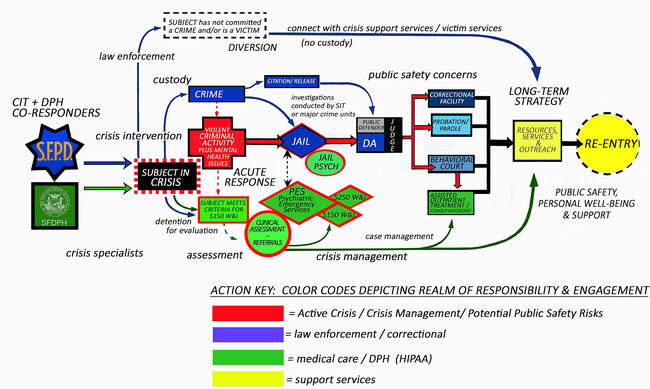
CO-RESPONDER CRISIS RESPONSE MODEL: CIT + DPH
This Co-Responder Crisis Response model demonstrates the division of crisis intervention responsibilities pertaining to law enforcement (CIT) and DPH Crisis Specialists.
When engaging a subject in crisis, both SFPD (CIT) and Crisis Specialists (DPH) work together in the interest of preserving public safety and preventing on-going crisis. Police initiate law enforcement actions, conduct criminal investigations when applicable, and connect subjects with appropriate services when feasible. Crisis Specialists conduct assessments, make appropriate referrals, and initiate services and resources as a part of longer-term case management.
"THE CRISIS CLAUSE"
Government Code 164.512
This section deals with accounting of disclosures of protected health information. HIPAA does not apply during the management of an active crisis. This code requires proper articulation of a crisis, and or the "timeline" of a crisis. (The Health Insurance Portability and Accountability Act restricts access to individual's medical information.)
164.512(a)(1) states an individual has a right to receive an accounting of disclosures of protected health information made by a covered entity in the six years prior to the date on which the accounting is requested, except for disclosures:
164.512 (f) (1) (C) (1): The information sought is relevant and material to a legitimate law enforcement inquiry
HIPPA DOES NOT APPLY
A PATROL-BASED APPROACH to CRISIS MANAGEMENT
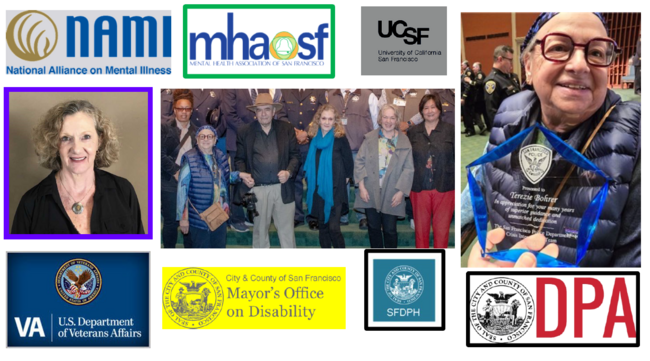
COMMUNITY INVOLVEMENT: THE CIT WORKING GROUP
The CIT Program works towards the highest standards of crisis intervention by listening to the needs and experiences of the communities we serve, mental health professionals, and advocacy groups...and implementing best practices.
The Crisis Intervention Team is committed to establishing an ongoing commitment to best practices. Because we serve and protect many diverse communities, we strive to understand the needs, expectations and concerns of our City.
The CIT Working Group is a civilian advisory board comprised of dedicated civilian Community Stakeholders with both personal and professional commitment to Crisis Intervention. The working group members have a wide variety of personal and professional expertise ranging from lived experience and/or represent various platforms such as; Mayor’s Office on Disability, SFDPH, Department of Police Accountability, National Alliance of Mental Illness, University of California San Francisco, Veteran’s Affairs, and several other groups.
Together they work with SFPD CIT Unit towards clarifying important issues, recognizing CIT goals, and improving the practice of crisis intervention. The CIT Working Group has contributed significantly to the advocacy of CIT Training and department-wide initiatives.
BENEFITS of CIT LIAISON PROGRAM CONCEPT:
- APPLICATION OF INSTITUTIONAL KNOWLEDGE: Working patrol CIT Officers are most knowledgeable of district issues, and are best suited to inform DPH directly regarding the issues and subjects who require assistance and consideration. Direct Source information for maximum efficiency.
- ACUTE CARE and LONG-TERM CARE APPROACH: This model is based on interdisciplinary and interdepartmental components and encourages patrol to be involved in helping connect subjects from acute emergency care, and into longterm support and services whenever feasible.
- PRIORITY-BASED TRIAGE: Lessens the overall volume of general cases and repeat incidents handled by patrol.
- DIRECT RESPONSIBILITY: Expands accountability and encourages competent responsibility throughout patrol and City Agencies and Programs.
- POSITIVE COMMUNITY ENGAGEMENT: heightens visibility of CIT-related principles out in the field: immediate outreach and response.
- BUILDS INTERDISCIPLINARY RELATIONSHIPS: Expands fabric of partnership between SFPD personnel and DPH Crisis Specialists and SFFD Street Crisis response. Builds functionality and trust, yielding superior results for those needing help and intervention.
- EFFECTIVE RESOURCES: Assists DPH in accessing subjects and connecting services in the most immediate and direct fashion.
- BEHAVIORAL THREAT ASSESSMENT: District-based engagement facilitates opportunity for follow-ups and check-ins with subjects, especially those who have presented a public safety concern for violence and/or behavioral threat potential.
SFPD CRISIS INTERVENTION TEAM
Main Number: (415) 242-3090
[email protected]
Lt. Donald Anderson
Officer In Charge
Email: [email protected]
Sergeant Elizabeth Prillinger
Email: [email protected]
A/Sergeant Carlos Manfredi
Email: [email protected]
Officer Christopher Cotter
Email: [email protected]
Officer Keith Murphy
Email: [email protected]
Officer Nicholas Zerga
Email: [email protected]
Officer John Ishida
Email: [email protected]
Officer Matthew Nazar
Email: [email protected]