26-093 Interacting with Autonomous Vehicles
Department Notice
Technology evolves quickly, often outpacing legislation. California now allows Autonomous Vehicles (AVs) to pick up passengers with or without a safety driver. Oversight of AVs falls under the California Public Utilities Commission (PUC) and Department of Motor Vehicles (DMV), which may propose changes to the Vehicle Code (VC).
This Department Notice (DN) provides information on AVs and outlines procedures for interacting with them. Given the fast-paced advancement of AV technology, unanticipated situations will arise. Members should consider the overall circumstances and exercise reasonable judgment, prioritizing public safety in all decisions related to AVs.
Law Enforcement Interaction:
- Members are informed that all AV interactions involving law enforcement, and the public are both audio and video recorded. These recordings can be accessed for investigative purposes.
- Live monitors oversee the AVs and can communicate through the AV. Members are requested not to open the vehicle for non-emergency issues. The remote operator monitoring the AV will lower the window to communicate with members.
- Members should only conduct a traffic stop of an AV when there is a legitimate law enforcement reason. For example, members should not pull over AVs merely to check if the required DMV AV permits have been issued.
- AVs must follow all standard road rules and VC provisions without exception.
- Members conducting a vehicle stop on an AV should use their forward-facing emergency lights to initiate the stop. The vehicle needs to recognize that the emergency vehicle is conducting a stop versus yielding to an emergency vehicle. Do not turn the forward-facing emergency lights off until the vehicle stop is concluded.
- When officers close off streets due to crime scenes or accidents, it is important to note that autonomous vehicles may not detect crime scene tape. If possible, reflective cones should be placed in areas that will be left unattended by an officer to ensure the closure is maintained.
Vehicle Code Violations:
Effective July 1, 2026, officers may issue a DMV OL 325 Notice of Autonomous Vehicle Noncompliance to any AV that the officer has witnessed commit a violation of the California Vehicle Code or local traffic code. This form may only be issued to Autonomous Vehicles which operate at SAE levels 3-5.
Society of Automotive Engineers AV Levels:
Level 0: No Driving Automation
Level 1: Driver Assistance
Level 2: Partial Driving Automation
Level 3: Conditional Driving Automation
Level 4: High Driving Automation
Level 5: Full Driving Automation
See SAE J3026 Chart below for details.
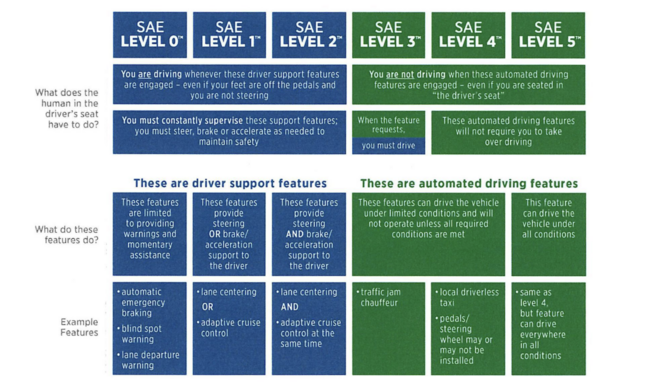
When an officer observes a violation of the CVC committed by an AV, the officer may affect a traffic stop on the AV. Officers will have to determine if the vehicle was being driven by a human or automated driving technology (Levels 3, 4, or 5). If the officer determines the issuance of the DMV OL 325 form is warranted, follow the instructions below.
Section 1: Instructions to Officer
- List the date, time and location of incident.
Section 2: Vehicle information. (enter entire VIN #)
Section 3: Safety Driver or Human Driver Information
- If there is no safety driver behind the wheel, check the Not Present In Vehicle box.
Section 4: Remote Assistance Information
- If there is no interaction with the remote operator, check the No Interaction box.
Section 5: Disposition of Vehicle
- Check the appropriate box here, indicating how the AV will leave the scene after issuing the DMV OL 325 form.
- If the vehicle drives away autonomously, check the No Human Driver box.
- If the vehicle is driven away by someone, list the name of the individual who drove the vehicle from the scene in the box to the right.
- If the other box is checked, please explain.
Section 6: Observed Driving Behavior
- List the CVC section which was violated and give a brief description of the violation. List any statements from the safety driver or witnesses.
- IMPORTANT If the officer deems the operation of the AV to be a clear or potential danger to persons and property, mark the Notice of Priority Noncompliance box.
Section 7: Issuing Agency Information
- Fill out the issuing officer's information along with the agency address and sign the form.
- Explain if a copy of the DMV OL 325 was not left inside the AV.
Once filled out and the last page (pink) was given to the safety driver or left in the vehicle, make a note in CAD that the DMV OL 325 form was issued and send the top two pages to Traffic Administration, DMV liaison officer through inter-departmental mail.
IMPORTANT: If the Notice of Priority Noncompliance box is checked please email a copy of the face page of the DMV OL 325 form to [Redacted], and send the original OL 325 form to Traffic Administration, DMV liaison officer thru inter-departmental mail.
- Parking Violations: Members may issue a citation for parking violations. Send a copy of the citation to the Commercial Vehicle Unit at Traffic Company.
Traffic Crashes:
- Both injury and non-injury crashes involving an AV, whether physically operated or remotely monitored, shall be documented in a collision report (CHP555).
- Forward copies of completed reports to the Commercial Vehicle Unit at Traffic Company.
Disabled or Malfunctioning Autonomous Vehicle:
In the event that AVs become disabled due to programming or mechanical issues:
- Companies will be promptly alerted to this situation, and live response teams are available to address it typically within 5-15 minutes.
- Contact either the safety driver or the remote monitor.
- Do not attempt to move the AV under any circumstances.
- If necessary, provide traffic control and await the arrival of the responding team.
- Do not issue a citation to an AV for being disabled.
Exigent Circumstances:
When an officer needs to manually control an AV to move it from a scene, the following are guidelines which can vary from company to company:
- Contact the remote operator, identify yourself with agency name, last name, star number, and reason for emergency control.
- Drive the vehicle only enough to clear the emergency.
- Park the vehicle legally if possible.
- Inform the remote operator of completion and vehicle location, then lock the vehicle.
- If the vehicle does not have any controls for the officer to drive it, then the officer will direct the AV via remote operator, or have it parked in place if movement would constitute more of a hazard.
- Effective July 1, 2026, Officers or Supervisors can call the AV company using the law enforcement number on the vehicle and request a geo-fence around the incident area to prevent further AVs from entering, especially during long incidents and events. This would require the AV company to direct its fleet to leave or avoid the area identified within 2 minutes of receiving an emergency message.
/s/
DERRICK J. LEW
Chief of Police